We are a group of like-minded growers of edible and useful heritage plant varieties in the Bellingen area of northeast New South Wales, Australia.
Our climate varies from frost-free coastal areas to inland river valleys and highlands with frosts. Bellingen has an average annual rainfall of 1507ml.
In
November we visited Tricia's garden in Brierfield.
Debbie
Kent, an entomologist who has worked for both the NSW Department of
Agriculture and NSW Forestry, identified any insect brought to the
gathering.
This plant
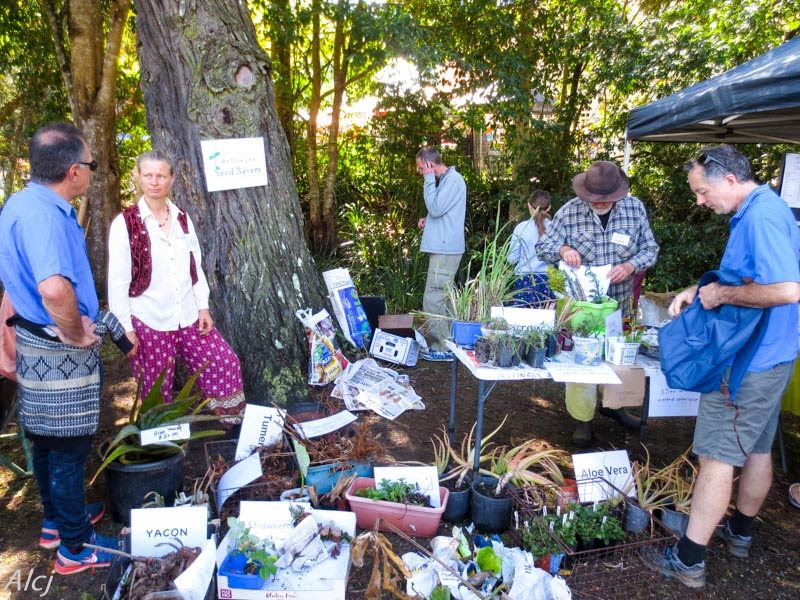
fair was bigger and
buzzing more than usual.
The word on the ground
was that shifting the
produce market to the
same venue for the day
was really making a
difference.
What do we do
with the money raised?
It's a fair question
that comes up from time
to time. We are all
volunteers, and the
money raised pays for
our running costs such
as insurance, the
website, the seed
packets, bags and labels
and printer ink. We have
purchased extra tables
and had banners printed
for the stall in the
past and this time
around we bought new
tablecloths for the
stall, at last. We will
be getting a second
gazebo of our own too as
the one lent to us by
Debbie has proved very
handy - thank you
Debbie.
BSS seeds will soon be
available in the
Bellingen Library. We
are having a seed stand
crafted by a local
cabinet maker. Stay
tuned, you will soon be
able to get seeds at any
time of year, not just
at the plant fairs.
We are also looking to
secure a mushroom
growing workshop in
Autumn (we missed out
last year) and we are
cooking up another
weekend away, both to be
subsidised by BSS for
active members.
Three
carloads of us carpooled
down to near Taree in
time for the advertised
start time of 10am. Only
to be told that the day
had been cancelled at
the last minute due to
the carpark ground being
too soft. However, we
were hardly the only
ones who didn't get the
memo in time, and within
half an hour,
approximately 50 people
had gathered in
expectation of the days
offerings.
They decided to run the
day after all.
We were all led around
the property for a farm
tour.
Greenpatch have
been growing organic
seeds for edible plants
for 25 years from this
little 5? acre plot. Plantings are dense,
crops are rotated, they
have their irrigation
system and mulching
figured out. To prevent
unwanted cross
pollination within plant
families they use fruit
fly netting. This covers
the other crops in the
family to exclude
pollinators while the
first one, the most
ready to set seed, is
left uncovered. They do
this on a grand scale.
Their seed cleaning
equipment is not much
more sophisticated than
ours. Their sieves are
larger and they use a
fan on a gentle setting
for winnowing. For some
seeds there is a sifting
machine - a barrel
shaped sieve run by a
motor.
We were also given a
seed sowing and
propagation
demonstration, and a
talk on native stingless
bees.
In between, we feasted
on an impromptu morning
tea and lunch that was
magnificent.
Greenpatch have a huge
variety of open
pollinated heritage
organic seeds for sale,
as well as useful
gardening bits and bobs
including their fruit
fly netting. https://www.greenpatchseeds.com.au/
Thanks to Jeff for all
our photos.
We will be
carpooling to this
event, to arrive in
time for the Farm
Tour at 10am. Please
RSVP if you would
like to be included
in the carpool,
otherwise, see you
there!
Entry: FREE
Tea & Coffee
Provided
Where: Greenpatch
Organic Seeds, 109
Old Bar Rd,
Glenthorne, NSW 2430
Turn off the Pacific
Highway at the Taree
South exit taking the
Old Bar exit and
follow Old Bar Road
for 900 metres. The
property is on the
left hand side.
Includes:
See
where we grow over
200 varieties of
seeds and 500
varieties of nursery
plants propagated
onsite.
Take
advantage of over 70
years horticultural
experience on the
day.
Self
Guided Tour. An
excellent experience
plus an opportunity
to take a rest and
enjoy the gardens we
have developed.
10am –
Farm Tour including
orchards, herb &
flower gardens,
nursery production
& vegetable seed
cropping.
11am –
Bee keeping.
Anna & Sven from
Amber Drop Honey are
local environmentally
minded bee keepers
passionate to share
their wisdom. Workshop
information is to be
confirmed.
12pm -
Lunch will
be served for a gold
coin donation. BBQ -
German Sausages,
Vegetarian options
& Salad. Tea &
Coffee provided. Enjoy
the music from ‘Dingo Creek String Band’
12.45pm
– 2pm Plant
Propagation workshop
covering the basics of
Seed Raising,
Divisions &
Cuttings. Neville a
horticulturalist has
been propagating
plants in a commercial
setting since the late
1970’s so he will be
teaching you from his
own experiences.
All Day
– The nursery and
shop will be open
from 10am to 2pm if
you would like to
purchase seeds and
plants or seek
gardening advice.
Biocast+
with Lee
Fieldhouse from Islands in the Stream will also
be available all day
with his wealth of
knowledge. He will
also have his Biocast+
products available on
the day.
Sunday
November 18, 1pm -
4pm
and address
unknown for web
rsvp
Brierfield
In November we visit
Tricia's garden in
Brierfield, which is a
delightful setting for
a Q&A gathering,
despite the lack of
vegie garden action.
Start collecting your
questions and
specimens. Our
resident entomologist
Debbie will be
identifying your bugs!
Bring them in sealed
containers only, we
don't want them to
spread.
Also bring your
gardening questions to
share with the group.
Together we can find
you some answers.
"This bean was given to me by a very charismatic seed saver who led a
lively workshop at the recent skill swap that I attended & taught
at. He shared some very interesting points about why it is important to save your own seeds:
* Every seed has a story to tell & can preserve history if the story is told.
* Cultivars that are descended from plants grown in an area are adapted to the micro-climate of that area.
* Being dependent on seeds suppliers that are hundreds of miles away is NOT food security.
This stunning, multi-colored corn is real
and edible, and its seeds are now in high demand. It’s a good thing
someone spent time saving the seeds over the generations when the
variety was out of our collective consciousness.
What is Glass Gem corn? It’s an old variety of corn with kernels that
come in an absolutely stunning array of colors. It’s also a reminder
that there are varieties of fruits and vegetables that we’re in danger
of losing, and it would be a real shame if we lost them…"
food plants, was
begun informally in 1932 by my grandfather H. Ralph Weaver (1896-1956).
During the Great Depression, when food was scarce for many households,
he set out to feed his family from a one-acre plot in West Chester,
Pennsylvania. Since he had been working on the Weaver family genealogy,
my grandfather used his Lancaster County family connections to acquire
heirloom seeds that had been grown in the Dutch Country for many
generations. His passion for rare old-time varieties snowballed so that
by the 1940s he managed to create one of the finest kitchen gardens in
Southeastern Pennsylvania. Among the many frequent visitors to his
garden was West Chester folk artist Horace Pippin from whom he acquired
many rare peppers. My
grandfather’s untimely death brought an abrupt end to his chapter of
the Roughwood Seed Collection story.
Some 10 years later, while a
student at the University of Virginia, I discovered his seed collection
at the bottom of my grandmother’s deep freezer. My grandfather knew that
by freezing seeds they could be kept for a long time, so by this stroke
of luck, many of his most valuable seeds were still viable when I began
to tinker with them. By the mid-1970s I brought most of his original
garden back under cultivation."
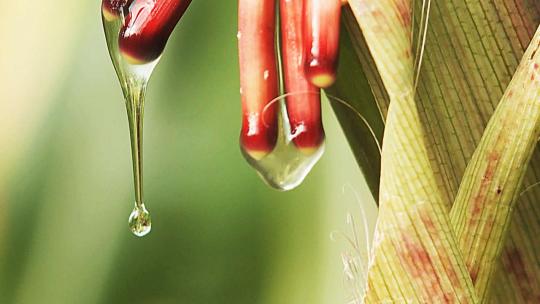
THEY FOUND NITROGEN-FIXING CORN BRED BY INDIGENOUS PEOPLE IN MEXICO. @botanyshitposts
“The study found the Sierra Mixe corn obtains 28 to 82 percent of its nitrogen from the atmosphere. To do this, the corn grows a series of aerial roots. Unlike conventional corn, which has one or two groups of aerial roots near its base, the nitrogen-fixing corn develops eight to ten thick aerial roots that never touch the ground.
During certain times of the year, these roots secrete a gel-like substance, or mucilage. The
mucilage provides the low-oxygen and sugar-rich environment required to
attract bacteria that can transform nitrogen from the air into a form
the corn can use.
This is a variety of useful recipes plucked from the net for making a jam or spread. There are source credits after the recipes for links to the original sites. There is no need to do without jam just because you are avoiding high energy sweeteners like sugar, honey and various syrups. Please take notice of the recommendations regarding the use by periods.
I boil down our home grown cumquats with only a very small amount of sugar and a little water to make a delicious sauce or runny jam, perhaps I will now try cooking down citrus without any sugar or use stevia to sweeten. Happy experimentation.
"Australia has a wide range of climates from the wet tropics to cool
temperate climates and it is important to consider your climate when
selecting trees that will be best suited to your area so they will
thrive and be productive once planted. This map from the Organic
Gardener Magazine is an excellent example of a climate map that will
help you to understand what type of climate you live in.
More than meets
the eye in this new
Fernmount garden:
Tim and
his growing family
have been living in
what was a vacant
block for just over a
year now, some of you
may be familiar with
it as the former
'Secret Garden'
nursery. Lots of
planning, passion and
effort has netted him
a food forest, jumping
out of the ground out
and proud, in the
front yard. An
unorthodox style, but
then a little chaos
always brings
opportunity. Around the back there
is more
experimentation and
innovation with
livestock and
microclimates; endless
fun and education for
his kids.
Inspirational! Tim has a
lot of plans and ideas
and thankfully for him
and his family, also the
energy of a kelpie to
make them happen. In
just under a year he has
moved a house onto an
empty plot, moved the
family in, cleared a
creekbed, set up
chickens, sheep and a
pig run, and planted out
the entire front area as
a baby food forest
that's easy to mow
around.
What grows well, grows
well and what's too
fussy is left behind.
Tim had a bunch of ways
of propagating that
don't waste time. The
easiest way to plant a
tomato is to get a ripe
one and squish it into
the ground where you'd
like more to grow.
We saw a broadfork in
action - it's a giant
garden fork that's more
effective and more
efficient for aerating
or turning over new
ground.
We were introduced to a
bunch of fertiliser
ideas. Throw the manure
in with the chickens to
scratch up, eat the
seeds and break down.
Give the scraps to the
pig.
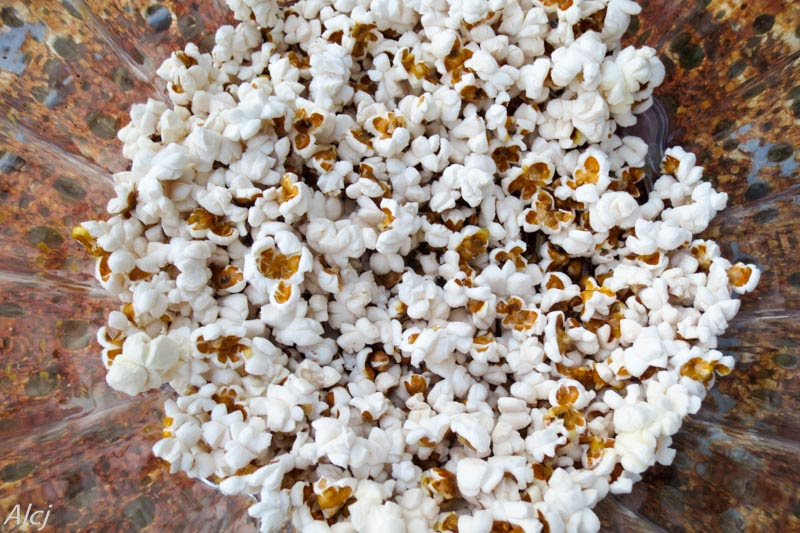
Home grown popping corn
and a table groaning
with cakes were very
much enjoyed too.
The
3-book series "Lost Crops of Africa" (Volumes I, II and III on Grains,
Vegetables, and Fruits, published in 1996, 2006 and 2008, respectively)
is a treasure for us all, but especially
for the African continent, with the hope it presents of growing food
security for its 1 billion people!