About Bellingen Seedsavers

We are a group of like-minded growers of edible and useful heritage plant varieties in the Bellingen area of northeast New South Wales, Australia.

Our climate varies from frost-free coastal areas to inland river valleys and highlands with frosts. Bellingen has an average annual rainfall of 1507ml.

Showing posts with label Panama Berry. Show all posts

Sunday, 10 February 2019

A local garden in February 2018


When Paul from Barefoot Gardens trims our front hedge it makes such a difference.

New garden
 The removal of the nine years old Panama Berry left a sunny space for Salvias, Turmeric and Amaranth. We have planted a new Panama Berry below our shed. The berries taste like boiled lollies.


Great for green goodness in warmer latitudes.
Chaya Spinach Tree
 Photographed from our deck the top of this 2.5m Chaya Spinach Tree appears like a green mound of green goodness.

An excellent Asparagus substitute
Surinam Spinach
Surinam Spinach is great Asparagus substitute.

Crepe Myrtles, pink, mauve and white, are in full flower throughout our district.
Crepe Myrtle
Crepe Myrtles, pink, mauve and white, are in full flower throughout our district.

Thursday, 26 December 2013

Growing on December 26 in the southern hemisphere, a warm temperate/subtropical garden


Banana Passionfruit

Pumpkins, Carambola, Pecan Trees

Yellow flowered edible hibiscus with red hybrid canna

Choko on Carambola tree

Salvias at front of pic

Pineapples at front, beans on teepee, garlic in pots

Panama Berry

Protecting the mangoes from the flying foxes.

Salvia with yam growing through the bush.


Tamarillo

New vine spikes on yam


Thursday, 4 April 2013

Fruiting May 4, 2013 near Bellingen NSW

Here we are about 8 km from the sea on a north facing slope in a river valley. What can we grow? What is fruiting today. Here are some fruits ready for harvest.
Panama Berry


Often described as the Lolly Tree the ripe fruit is intensely sweet. Half coloured is therefore a better taste. We have three trees. The birds eat most.


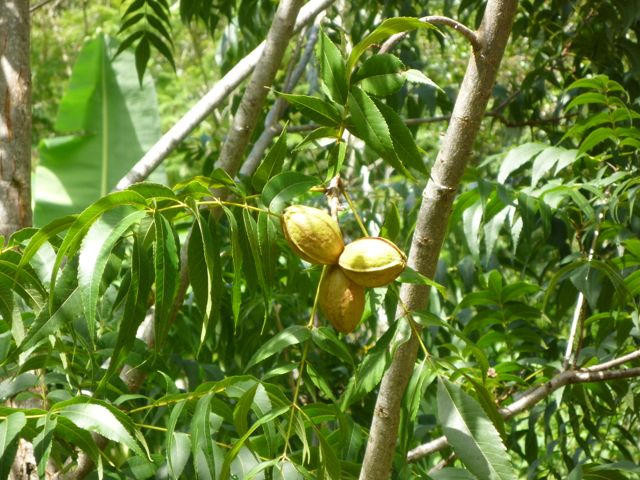
Pecan Nut


 This is the second year of fruiting.


Five Star Fruit (Carambola)

Kent Pumpkins can grow like weeds.

Tamarillos love this climate.

Tuesday, 8 March 2011

Edible Plants Thriving in Early March


The following edible plants are enjoying the rain, humidity and remaining high temperatures of early March in the Bellingen Valley. Soon the cooler weather, and it some cases frost, will cause some of the cold sensitive vegetables to die off or become dormant. What plants are growing strongly in your area at this time?

Wing Beans (Psophocarpus tetragonolobus) love the subtropical conditions of our summer.


The bean pods are delicious in stir fries. The plant regrows from the roots as the summer heat returns.

The whole plant is edible and the shoots can be eaten.
A ripe Panama Berry (Mutingia calabura) tastes like a boiled lolly.
The Panama Berry flower


It is a useful small tree
Yacon (Smallanthus sonchifolius). The tuber is eaten like a sweet potato.
Crookneck zucchine loves the slightly cooler weather of March.
A mild sweet capsicum is so useful given the prices in the greengrocers.
The capsicum (mild peppers) are small but plentiful.


This Rocoto (Tree Chilli) is three years old and prolific. The birds eat many and this is O.K. because the fruit is so hot. We use these very sparingly.
Brazilian Spinach also loves this weather. It's best cooked although it is often used in salads.
Egyptian Spinach (Corchorus olitorius) can be dried and used to thicken soups.  The Arab name is "Molokhia." Its bland leaves (without any bitterness) make a great salad.

Taro had a growth burst in high summer. It loves the rain.


Daley's Nursery's says that Taro can be substituted for potato in any dish. I've yet to try it. Do any readers have a favourite recipe for Taro? If so, please add to the blog using the comment facility.


This Panama Berry has been in the ground for two years. It was 30 cm high when planted. It lost some leaves last winter but remained in leaf. It is a useful small tree and it is being trained away from the lawn. The fruit is delicious but only a cm in diameter.


LinkWithin


Related Posts Plugin for WordPress, Blogger...

LinkWithin

Related Posts Plugin for WordPress, Blogger...