A recipe from New Earth Cooking that uses green jackfruit, green papaya, garlic, ginger, shallots and other tropical produce.

Showing posts with label jackfruit. Show all posts
Showing posts with label jackfruit. Show all posts
Sunday, 15 January 2017


Tuesday, 15 April 2014
Growing Jackfruit, Grumichama and White Mulberry in the Bellinger Valley

Grown from seed, this Jackfruit plant is five years old and has finally carried fruit to maturity.
It is planted in a sunny position, well drained but not irrigated. The temperature did not drop below one or two degrees Celsius in the previous winter.


This mature Grumichama (gold) plant produced fruit in summer. Black fruited Grumichama seems less productive. A young Saba (Malabar) Chestnut is in the foreground.
Eating mulberry leaves
 |
| A White Mulberry growing near Bellingen |
 | |
| Coppiced edible-leaf mulberry rows on contour beneath nitrogen-fixing acacias at Las Canadas in Mexico. perennialsolutions.org |
"Mulberry (Morus alba) White mulberry leaves are cooked and eaten in at least several areas of Latin America. Cuban research has led the way to greater exploitation for human consumption. They are very high in protein, and selected varieties have very good flavor and texture. Fresh leaf yields can reach an astonishing 53 tons per hectare. Much is known about coppiced mulberry leaf production as it is a critical fodder for silkworm production and also widely used as a fodder for other livestock. Now perhaps it it taking its place as a human fodder as well.
Link 'Perennial Solutions '
1. Lamb Stuffed Mulberry Leaves (not necessarily White Mulberry leaves)
2. Fried Mulberry Leaves: "They have so many items made from the mulberries, wine (which was sweet and so good), tea and even fried mulberry leaves. They are delicious, even the boys ate them."
oursonnylife.com
3. Mulberry Leaf Tea
4. How to Eat Mulberry Leaves in a Salad
Step 1 "Collect young, unopened mulberry leaves in the spring. Once the leaves mature and open, they are toxic and no longer edible, naturalist Steve Brill warns in his book "Identifying and Harvesting Edible and Medicinal Plants in Wild (and Not So Wild) Places."
Step 2 Rinse the leaves in running water to clean them, then boil them for 20 minutes.
Step 3 Drain the water and pat the cooked leaves dry with paper towels.
Another LINK: Trees/or shrubs with edible leaves?
mb-Stuffed Mulberry Leaves
Lamb-Stuffed Mulberry Leav
Monday, 8 October 2012
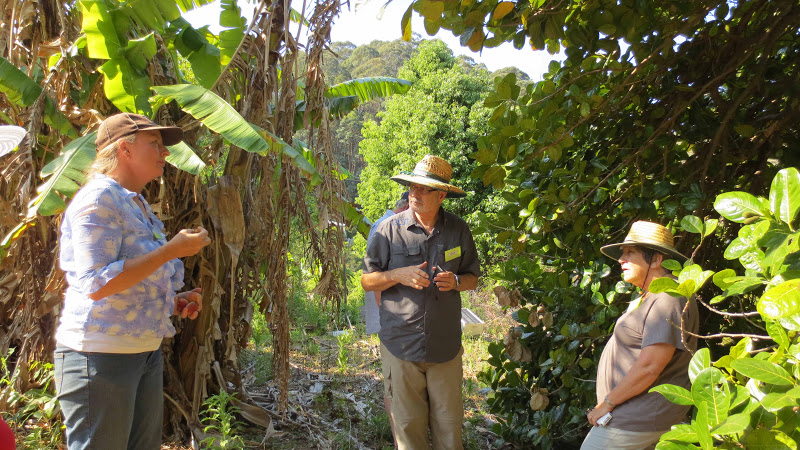
Bellingen Seedsavers visit Susan's banana farm
Susan is aiming at restoring her acquired banana farm to better health. The steep slopes are being planted with seedlings of other fruit trees, especially mango and avocado seedlings. She has stopped all spraying and is planning for certain plants to overwhelm weeds.

The steep slopes are prone to erosion especially in the high rainfall of the Coffs Coast.

Macadamias grown from the nuts are being propagated for adding to the biodiversity of a food forest.

This mature mango helps to retain the steep slope.

A wild native raspberry flourishes. Some find these fairly tasteless but others enjoy the taste. Be careful to control the runners.

Coriander, in the vegetable garden, flowers and attracts useful insects.
 Fennel grows well at this time of year.

Silver Beet produces more when the outside leaves are regularly picked.

This Jack Fruit has been producing fruit for some years. With no extra irrigation it is surviving the very dry weather....

.... and producing fruit.

This joey was found in the pouch of its mother, killed on a road. Here he attempts to climb into a non-existent pouch


These gluten free pumpkin, feta and sun dried tomatoes were enjoyed at afternoon tea.

Irene grew this whopper of a pineapple. The size surprised us, our climate not being really subtropical.

Hong Kong Taro is a smaller variety of taro. Irene had brushed off the soil gently, and brought the taro to the boil in cold water with salt and five spice powder.
She simmered the covered pot for 10 minutes then left the taro in the water to cool. This made it easy to peel the taro which tasted like a waxy boiled potato. The boiled taro would make an excellent 'potato' salad. The taro could be stored unpeeled in the 'fridge for a week.
As usual we shared plants and seeds from our seed table.

The new vegetable garden is well mulched in this dry weather.


The early ripe fruit on this peach tree is because of the north facing slope and our latitude.
We plan for our next garden visit to be to Bellingen's North Bank Community Garden on the second Thursday of November, November 8.

The steep slopes are prone to erosion especially in the high rainfall of the Coffs Coast.

Macadamias grown from the nuts are being propagated for adding to the biodiversity of a food forest.

This mature mango helps to retain the steep slope.

A wild native raspberry flourishes. Some find these fairly tasteless but others enjoy the taste. Be careful to control the runners.

Coriander, in the vegetable garden, flowers and attracts useful insects.
 Fennel grows well at this time of year.
Silver Beet produces more when the outside leaves are regularly picked.

This Jack Fruit has been producing fruit for some years. With no extra irrigation it is surviving the very dry weather....

.... and producing fruit.

This joey was found in the pouch of its mother, killed on a road. Here he attempts to climb into a non-existent pouch


These gluten free pumpkin, feta and sun dried tomatoes were enjoyed at afternoon tea.

Irene grew this whopper of a pineapple. The size surprised us, our climate not being really subtropical.

Hong Kong Taro is a smaller variety of taro. Irene had brushed off the soil gently, and brought the taro to the boil in cold water with salt and five spice powder.
She simmered the covered pot for 10 minutes then left the taro in the water to cool. This made it easy to peel the taro which tasted like a waxy boiled potato. The boiled taro would make an excellent 'potato' salad. The taro could be stored unpeeled in the 'fridge for a week.
As usual we shared plants and seeds from our seed table.

The new vegetable garden is well mulched in this dry weather.

The early ripe fruit on this peach tree is because of the north facing slope and our latitude.
We plan for our next garden visit to be to Bellingen's North Bank Community Garden on the second Thursday of November, November 8.
Subscribe to:
Posts (Atom)
LinkWithin

LinkWithin