
Nick has two gardens to show us, his first garden in Repton and his new garden in Repton. The first was on lower land and more humid and the second was on a hill and drier. We visited in October but what should have been early Spring was more like early Summer. Climate change is taking effect relentlessly.
Here is a link to Nick's site with descriptions of the plants he grows.
"The first garden is 20 years old with permaculture planning on a flat, alluvial site. It includes an owner built passive solar house, vegies, fruit trees, clumping bamboo and rainforest restoration. The other garden is 6 years old, on a hilltop close by but very different – more windy, drier and with poorer soil. Climate change is making things tougher still, so I’ve learnt a lot about water conservation and regenerative gardening."
Nick grows many perennial vegetables.
Rhubarb is growing strongly in our gardens because of the extra rain and warmth. Rhubarb will require shading in Summer.
Here is a link to Nick's site with descriptions of the plants he grows.
A Guide to Crops for the Bellinger Valley and their ... - ecoliving design
Nick says:"The first garden is 20 years old with permaculture planning on a flat, alluvial site. It includes an owner built passive solar house, vegies, fruit trees, clumping bamboo and rainforest restoration. The other garden is 6 years old, on a hilltop close by but very different – more windy, drier and with poorer soil. Climate change is making things tougher still, so I’ve learnt a lot about water conservation and regenerative gardening."
 |
| Nick's first vegetable garden is in Zone 1. The drums contain compost tea. |
 |
| Nick's first vegetable garden is in Zone 1 |
 |
| Nick's bamboo grove has building and eating bamboos. |
 |
| Nick has a cotton plant now a 2m woody shrub. |
 |
| These flowers on one of Nick's mangoes belong to an Asian variety |
 |
| Nick's mulberry is heavy with fruit. |
 |
| Nick in front of his garden |
 |
| As usual Seedsavers enjoyed an early afternoon tea |
 |
| Asparagus seedling |
 |
| A pond for edibles is sited near Nick's roof. |
 |
| A native Hop Bush in the front garden. |
 |
| Nick demonstrates his levelling device for creating swales. |
 |
| Nick has new Lotus Plant that will need a larger pond. |
 |
| Growing seedlings in a warm spot. |
 |
| A pile of tree lopping mulch used around vegetables. |
 |
| Is this Celtuce? |
 |
| A raised garden uses water run off from the first catch water filter. |
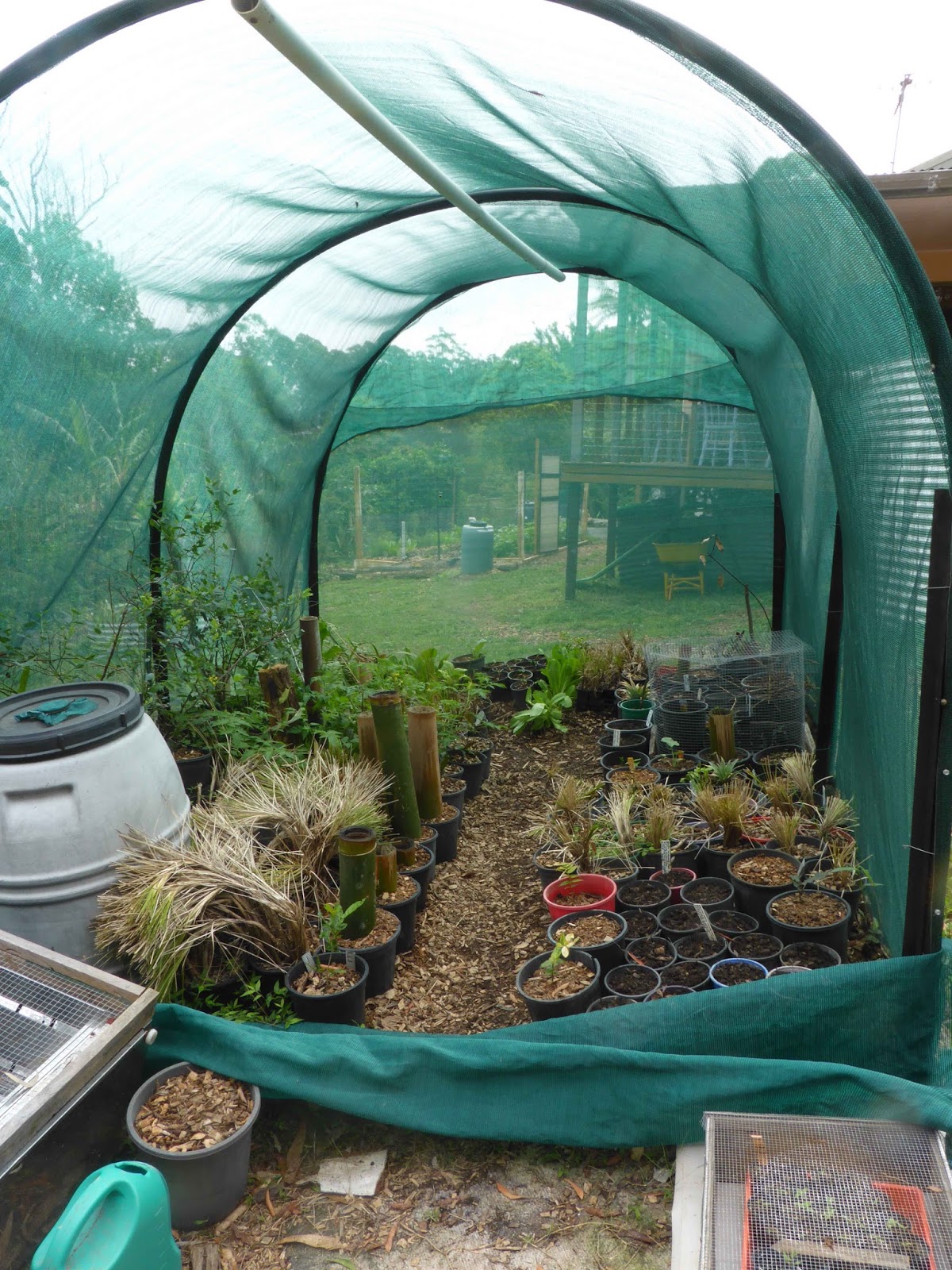 |
| The shadehouse |
 |
| Swales make the steep block usable. |
 |
| Another raised garden near the house in Zone 1. |
 |
| Raised bed with annual and perennial vegetables |
 |
| Warrigal Greens |
 |
| This is a homemade first run off filter. |
 |
| Papayas |
Papayas are usually called Paw Paws in Australia and are not to be confused with North American Paw Paws which are a different genus.
Member Jeff has added some more pics for you.
 |
| River forest adjacent to Nick's first garden |
 |
| Native Staghorns adorn the trees. |
Platycerium
is a genus of about 18 fern species in the polypod family,
Polypodiaceae. Ferns in this genus are widely known as staghorn or
elkhorn ferns due to their uniquely shaped fronds. Wikipedia
 |
| So we made a rhubarb slice! |
Rhubarb is growing strongly in our gardens because of the extra rain and warmth. Rhubarb will require shading in Summer.
 |
| Afternoon tea. The closest table holds our sign on register and name labels. |
 |
| Entering Nicks Bamboo grove. |
 |
| Dragonfruit (Pitaya) and Pineapples |


