About Bellingen Seedsavers

We are a group of like-minded growers of edible and useful heritage plant varieties in the Bellingen area of northeast New South Wales, Australia.

Our climate varies from frost-free coastal areas to inland river valleys and highlands with frosts. Bellingen has an average annual rainfall of 1507ml.

Showing posts with label Galangal. Show all posts

Tuesday, 24 December 2019

What's flowering and fruiting in late December in the Bellinger Rv Valley?

Coreopsis

Penta

Crepe Myrtle (Tuscan Red)

Bismarck Palm with Furcrea in foreground

Edible (tastes like Lemon Sorrel) Cranberry Hibiscus

Flowers on Star Fruit

Macadamia

Wax Jambu

Golden Grumichama

Black Grumichama


Tamarillo

Tamarillo

Brazil Cherry
 or Pitanga or Surinam Cherry

Salvia

Black self-seeded Passionfruit

Immature Kwai Muk fruit

White Penta

Galangal

Strongly Perfumed Brunsfeldia

 The local peach below has been grown in this valley for some decades and is well adapted to our climate. It fruited in midsummer.

Local Dwarf White Peach
Local Dwarf White Peach is picked when it looks green but starts to soften.

Friday, 16 November 2012

November visit to North Bank Community Garden in Bellingen


Chard
We had a turnout of twenty for this gathering and we were lucky that we were able to enjoy a fine day, followed that evening by a lovely big downpour.  We sheltered from the sun under the bamboo yurt for the first time, which worked well. Here are some of Jeff’s great photos.


Our seedtable


Before exploring the garden we broke into three groups;

(1) people from the coastal areas, 

(2) from the valleys 

(3) from the Dorrigo Plateau.  


Action at the seedtable is always brisk


Everyone shared their experiences of the highs and lows of coping with our unpredictable climate – what was growing successfully and what not, etc. During feedback time, the groups’ concerns and interests ranged over many topics.


The group shared garden lore


Group 1:  dry conditions/bush fires, watering, erosion control with herbs, dry shock but reduced weed growth, climate change, the benefits of Lady Beetles controlling aphids  (lots around at  present).  Use more mulch.  Visitor from Korea – discussion of crops;  also UN disaster relief work.
Asparagus bed

Comfrey and taro

 Group 2:  Basil - fungal conditions and rust – use of biodynamics –stir one cup of fresh Casuarina needles in a bucket of water;

 Strawberry propagation -  take plantlet closest to mother plant,

There were questions about sourcing sesame seeds to grow.

A grouping of edibles

Yarrow

 Group 3:  Weed control – tussock, thistle, ink weed, sword grass, wild tobacco, whisky grass.  Effects of dry weather on garden;  alpacas;  acreage use; 

Tip: old timers’ methods of weed control and old recipes e .g. molasses sprayed on tussock etc (cattle love molasses); 

  vinegar/salt - acts like Roundup;  dolomite;  lime sprayed on nettles, etc.   Just dig up!

  If you would like to contribute anything to these discussions, please email me or bring to the Q&A session on 2 or 16 December.


Zucchini


The tea table is always a place to share gardening stories and recipes for our produce.


Auntie Beryl's Processor Moist Orange Cake (left)

 Ingredients: 
 •  2 washed navel  oranges about 220 grams each
• 185 gm softened butter
• 1 1/2 cups castor sugar
• 1 teaspoon vanilla essence
• 3 eggs
• 2 1/4 cups self raising flour

Icing:
•1/2 cup white sugar
• juice of one orange

Method

• Preheat  fanforced oven to 160 degress C or 170degrees for non fan farced oven

• Grease 22cm spring form pan and line the base

• cut oranges into 1/4s and remove seeds

• place orange quarters in processor and pulse until chopped

• add butter, castor sugar and vanilla and pulse until combined

• add eggs and pulse

• add flour and pulse with small bursts until flour is all blended

• Bake 55 to 60 minutes...cool 10 minutes

• pour over icing syrup OR melt some chocolate (can use choc chips) and spread

Sunday, 18 March 2012

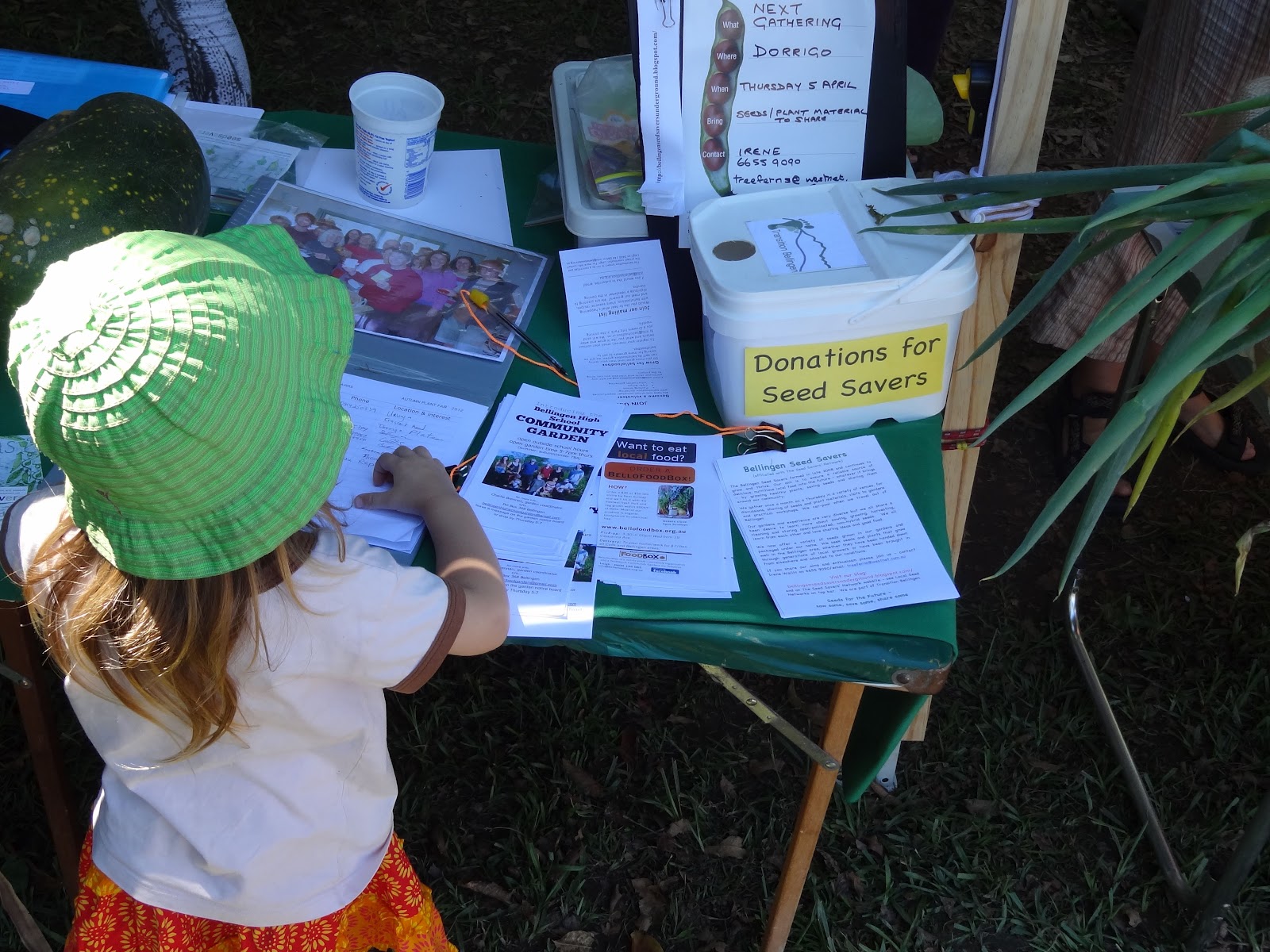
Bellingen Seedsavers at the Bellingen Plant Fair in March

A successful raffle of organic produce

Hi Seed Savers

Congratulations and huge thanks to everyone associated with our stall at the Plant Fair:  all the willing workers who participated in the seed-packing working bee;  propagated plant material and provided lovely home grown produce for the raffle prizes;  helped to set up the stall and the surrounding area and pack up at the end.  It was very satisfying to see the rather bare area when it was all over.  Hundreds of seeds are now in the hands and soil of the visitors, who I very much hope will "save some, sow some and share some".  The level of enthusiasm of visitors to the stall was overwhelming - it increases with each one. 

We will need to work hard to harvest seeds from our gardens to replenish our stocks for the Spring Plant Fair, so please save some of your best seeds for that purpose. 

Have you seen the kind words and great photos that Jude and Michele Fanton have on their website about their visit in September? :  http://www.seedsavers.net/seed-blog/workshops-bellingen-seed-savers-september-2011.  Cheers Irene

Busy, busy,busy


Click a pic to view pics in a slide show
A list of available seeds packaged by Bellingen Seedsavers


Some of the available plants


We appeal to all ages


A closer shot of the produce


More plants


More customers and staff


Bellingen High School Community Garden  holds working bees each Thursday 5pm. Details available at: working bees  


Siddhanta Hazell, teacher of Organics and Horticulture at TAFE for the last 10 years, will be offering free fruit and vegetable gardening advice at the Bellingen High School community garden on Thursdays from 5-6pm. People can bring their pests and diseases, their soil samples, their weeds, their worries, whatever. This service is part of the Garden's weekly gardening time for the general public, when you can get hands-on and dirty with garden tasks if you so desire or just wander and harvest and enjoy the burgeoning garden.Tools and equipment and tea making facilities available. The Garden entrance is off Crown St. See you there!


Food Exchange - Permaculture Collective MNC
10.30-12.30 Thursday 29 March - Church Street, outside Kombu (and alternate Thursdays)

Tuesday, 24 January 2012

Recipe for a very mild Sambal

This recipe uses local plants and spices. If you like a hot sambal add more chili.


Perennial Garlic at the reshooting stage

Perennial Capsicum, small but prolific

Lemon Grass

Rocoto Tree Chili - very hot

Galangal
Ingredients:

- One clove of perennial garlic
- Quarter of a hot chili
- A good handful of small red perennial capsicums or use a large capsicum
- 1/4 teaspoon dried nutmeg powder
- 1 onion, preferably mild, peeled and chopped
- 1 teaspoon salt
- 1 1/2 teaspoons-  chopped palm sugar

- dash of coconut oil. Coconut oil adds flavour. Don't use olive oil
- 2 Curry Tree leaf bunches
- 2 Lemongrass stems, bruised
- 1 cm Galangal, peeled and sliced. Fresh ginger could substitute.
- 2 tablespoons Tamarind paste or substitute lime juice
- 2 tablespoons salt

Directions

1. Combine first seven ingredients and grind or blend finely. If you are not bothered by a more fibrous sambal you can also blend the lemon grass and galangal added in the next step.

2. Heat oil and saute ground ingredients together with curry tree leaves, lemon grass and galangal, stirring until the mixture changes colour. Add tamarind juice and simmer for another minute, then leave to cool.

3. Remove curry tree leaves, lemon grass and galangal before serving.

4. It will last at least a week in the refridgerator.  I use a large dollop to stir-fry climbing or bush beans but use to stir-fry any suitable vegetables such as baby chokoes.

This recipe was an adaptation of an asian recipe. You can experiment and vary the ingredients to taste.

LinkWithin


Related Posts Plugin for WordPress, Blogger...

LinkWithin

Related Posts Plugin for WordPress, Blogger...