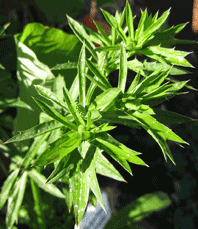
Bellingen Seed Savers also share plant material apart from seeds. Cuttings and plants of perennial edibles are distributed among our contacts.
Here is a variety of perennial edibles suitable for growing in the Bellinger River Valley. All have been grown by Bellingen Seed Savers members. Any of the fruits listed can be treated like vegetables. Can you suggest more perennials?
 |
| Katuk (Sauropus androgynus) |
'By now you should know Katuk is one of the most popular vegetable in the
world, particularly in Borneo and my home in Florida. Now some
information to keep the lawyers happy.....
So, what does all this mean, beside don’t eat Katuk if you are taking
something to open your blood vessels or lower your blood pressure? Enjoy
Katuk as an addition to salads, a lawn-side nibble, and cooked in
various dishes like you find in thousands of restaurants. Just don’t
consume a half a pound of it a day raw for weeks or months and/or while
taking an extract as well. I have been tossing a dozen leaves in my
weekly salads for more than five years. I ain’t concerned.' Eat the Weeds
 |
| Yam Bean |
 |
Purple Yam (Dioscorea alata)
Dioscorea
alata, known as purple yam and many other names, is a species of yam, a
tuberous root vegetable. The tubers are usually bright lavender in
color, hence the common name, but they may sometimes be white. Wikipedia
|
|
 |
Tamarillo,
is a small tree or shrub in the flowering plant family Solanaceae. It
is best known as the species that bears the tamarillo, an egg-shaped
edible fruit. It is also known as the tree tomato, tamamoro, and tomate
de árbol in South America. Wikipedia
| | |
 |
| Turmeric flower |
 |
| Taro mashed with coconut milk |
 |
| A grated green Paw Paw (Papaya) Salad |
 |
| Artichoke |
 |
| Olive |
 |
| Lemon Basil |
 |
| Kale |
 |
| Cassava |
 |
| Edible Hibiscus (smooth leaf form) |
"Yacon is a perennial daisy with clusters of yellow flowers (see above)
that grows to about four feet (one metre plus). It has furry leaves that
are nutritious and can be used like olive leaves to wrap food or cooked
like spinach as a green. The leaves contain quantities
of protocatechuic, chlorogenic, caffeic, and ferulic acids, and these
have prebiotic and antioxidant properties. You can also make the leaves
into a tea."
From Permaculture.co.uk
https://www.permaculture.co.uk/How-to-grow-harvest-eat-yacon
article
 |
| Perennial Capsicum |
 |
| Chives |
"Ripe carambolas may also be used in cooking. In Southeast Asia, they are usually stewed in
cloves and sugar, sometimes with
apples. In China, they are cooked with fish. In Australia, they may be cooked as a vegetable, pickled, or made into jams. In
Jamaica they are sometimes dried.
[1]
Unripe and sour type carambolas can be mixed with other chopped spices to make relishes in Australia.
[1] In the Philippines, unripe carambolas are eaten dipped in
rock salt.
[7] In Thailand, they are cooked together with shrimp.
[1]" Wikipedia
The flowers are acid and are added to salads in Java Reference
 |
Canavalia
gladiata, usually called sword bean, is a domesticated plant species in
the legume family. The legume is a used as a vegetable in interiors of
central and south central India, though not commercially farmed. Wikipedia
|
 |
The
Chinese water chestnut or water chestnut is a grass-like sedge native
to Asia, Australia, tropical Africa, and various islands of the Pacific
and Indian Oceans. It is grown in many countries for its edible corms. Wikipedia
|
 |
Cassava
Manihot
esculenta is a woody shrub native to South America of the spurge
family, Euphorbiaceae. It is extensively cultivated as an annual crop in
tropical and subtropical regions for its edible starchy tuberous root, a
major source of carbohydrates. Wikipedia
|
 |
Cranberry Hibiscus
Hibiscus
acetosella is an angiosperm of the genus Hibiscus or rosemallow. The
word acetosella is of Latin origin and is derived from an old name for
sorrel which comes from the sour taste experienced when eating the young
leaves of the plant. Wikipedia
|
| | |
|
 |
Comfrey
Comfrey
is a common name for plants in the genus Symphytum. Comfrey species are
important herbs in organic gardening. It is used as a fertilizer and as
an herbal medicine. Wikipedia
(use small amounts) |
|
|
 |
| Turmeric and Lemon Grass |
 |
| Asparagus |
 |
| Asparagus |
 |
Rhubarb is a species of plant in the family Polygonaceae. It is a herbaceous perennial growing from short, thick rhizomes. Wikipedia
 |
| Rhubarb stalks can be used as a vegetable in stews |
|
Green Harvest can supply many of these plants if you can't hook up with a local or make it to the Bellingen Plant Fairs.
 |
| Oca has succulent clover-like leaves and produces a small, pink, delicious tuber. Suited to cooler temperate
climates, tolerant of high altitudes and a wide variety of soil types.(Green Harvest) |
Oca should grow well on the Dorrigo Plateau. It finds the Bellingen Valley a little too steamy.
 |
| Peanuts can be grown from southern NSW to northern Australia
in areas with 5 months of warm frost-free weather. Green Harvest |
 |
| Sawtooth Coriander |
 |
| Lemon Balm |
 |
| Society Garlic |
 |
| Vietnamese Mint |
 |
| Zatar (Mother of Herbs) |
 |
Lebanese Cress
Aethionema cordifolium
Grows best in shallow water. Pic from Green Harvest |
 |
| Luffa or loofah are not susceptible to mildew like zucchinis. Eat young. (Garden Drum) |
Sorrell
Rumex acetosa meaning garden sorrel and
Rumex scutatus
meaning French sorrel are more often grown in herb or vegetable gardens
for their leaves which are typically added to salads, soups, omelettes
and sauces.
 |
| Moringa |
 |
| Bamboo shoots |
 |
| Malabar Chestnut |
 |
Rosella
...........................................................
The site below and other sites suggest eating other types of Alternanthera, a common plant in our gardens. |
http://www.homedesigndirectory.com.au/gardening/plant-finder/search-results.php?criteria=is_edible
"8. Joy weed, Alternanthera, Gomphrena (Alternanthera aurea)
Cultivar/variety: 'Exhibition Border Gold'
Alternanthera
aurea 'Exhibition Border Gold' is a colourful groundcovering perennial,
with small green leaves blotched with gold. Use as a contrast or accent
plant in warmer areas, or as an annual in cooler climates, as it is
frost tender. It makes a good low hedge...
...learn more about the '
Exhibition Border Gold'
variety
.
 |
9. Joy weed, Calico plant, Alternanthera (Alternanthera bettzickiana)
Cultivar/variety: 'Exhibition Border Red'
Alternanthera
bettzickiana 'Exhibition Border Red' is a colourful groundcovering
perennial, with small burgundy leaves blotched with bright pink. Use as a
contrast or accent plant in warmer areas, or as an annual in cooler
climates, as it is frost tender. It makes a good low...
...learn more about the 'Exhibition Border Red' variety"
Green Dean (Eat The Weeds) also says Alternanthera are edible. See below:
"There are many Alternanthera in warmer area so key out the plant carefully. A. philoseroides is the most common. Four known edibles are A. ficoidea, A sessilis, A. sissoo, and A. versicolor. A. sessilis is well-distributed in the U.S., A. ficoieda is rare. A. versicolor is found in Asia. A sissoo is a common green in South America but must be cooked."
|
For more information about perennial edibles
See also:
Bellingen Seedsavers
SAFETY
"Flowers and edible leaves can make a unique addition to salads, or
unusual edible garnishes. However, a few words of warning are necessary
to avoid potential trouble.
Gardeners should always use extreme caution in consuming anything
other than the familiar garden vegetable and herbs. Most growers,
ourselves included, avoid using toxic chemical sprays whenever possible,
but at times they are relied upon to control various insects and
diseases. Upon purchasing a plant, there is no way to tell whether or
not it has been recently treated with a pesticide product. Each
different chemical product has its own life span, the period that a
toxic residue may remain on a treated plant. To avoid contact with any
toxic residue, newly purchased perennials and herbs should not be consumed for a minimum period of at least 60 days after planting.Edible
flowers should be approached with great care, in general, because of
potential allergy problems in sensitive individual. In particular, anyone with an allergy to Ragweed or any other member of the Daisy family (Asteraceae) should never consume the flowers or any other parts of these plants. The link above and below will return a list of common members of this plant family.
Add any edible flowers to your diet in small quantities at first, to test the reaction of those eating them. Avoid giving any edible flowers to children under 7 years of age. Children should also be warned to never eat any flowers without the supervision of an adult.
Use extreme caution in selecting and gathering edible flowers, leaves
or any other plant parts. Just like with wild mushrooms, erring on the
side of caution is advised. If you are not 100 percent sure about the identity of an edible plant, DO NOT EAT IT, even in tiny amounts.
Avoid using any toxic plants as attractive garnishes, in case a dinner
guest (or anybody else not in the know) should accidentally consume it.
Poisoning your guests is not a pleasant way to end a dinner party!"
From http://www.perennials.com/content/edible-plants/