About Bellingen Seedsavers

We are a group of like-minded growers of edible and useful heritage plant varieties in the Bellingen area of northeast New South Wales, Australia.

Our climate varies from frost-free coastal areas to inland river valleys and highlands with frosts. Bellingen has an average annual rainfall of 1507ml.

Thursday, 4 April 2013

Our Seed Savers Working Bee - Making seed labels


Barbara is concentrating.
 Producing seeds for the two Bellingen Plant Fairs (and members) involves not just collecting the seeds that thrive in our local area. We have recently applied more finesse to our seed packaging. Volunteers are always welcome.

Irene watches Carol. Jeff works away in the background.


Fruiting May 4, 2013 near Bellingen NSW

Here we are about 8 km from the sea on a north facing slope in a river valley. What can we grow? What is fruiting today. Here are some fruits ready for harvest.
Panama Berry


Often described as the Lolly Tree the ripe fruit is intensely sweet. Half coloured is therefore a better taste. We have three trees. The birds eat most.


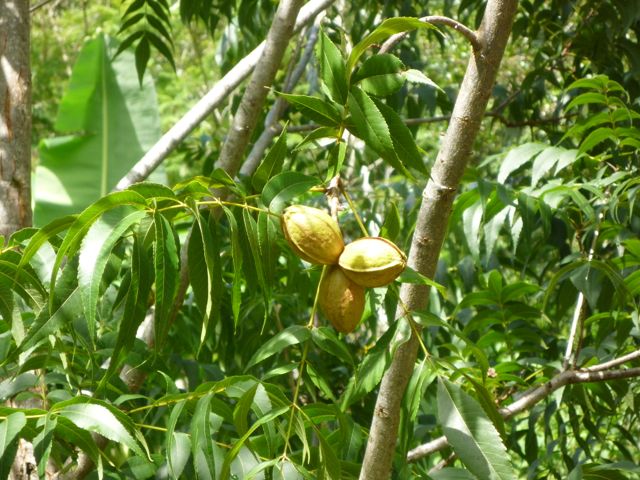
Pecan Nut


 This is the second year of fruiting.


Five Star Fruit (Carambola)

Kent Pumpkins can grow like weeds.

Tamarillos love this climate.

Friday, 22 March 2013

A visit to a Dorrigo farm: vegetables and poultry

Following a very successful plant-fair stall the previous week, Bellingen Seedsavers made a garden visit to Jodi and Michael's farm. This provided a fascinating look at how annual and perennial vegetables are grown in small market garden quantities.


We all found this mother duck fascinating.

The Dorrigo garden viewed from the road

Chicken tractors are used to prepare the garden beds.

A bank of green manure, salvias and comfrey.
Two slow clicks will enlarge each photo.
Narrow pathways and edging save valuable space.

A recycled timber pergola makes a perfect spot for Kiwi fruit and beans.

Annual vegetables are planted after the chickens.

Water is scarce, the volcanic soil drains quickly, so irrigation is necessary.
Enriching compost is made directly on the beds.

Before digging, black plastic solarises the Kikuyu grass.

The chicken tractor in the background matches the width of the garden beds.

Yacon is boiled down to a syrup..


A chicken tractor prepares for an orchard
.
Penned chickens prepare the soil.


Comfrey is cut to provide a green mulch.


This chicken tractor is moved each day.

Jodi demonstrates the 'broadfork'.

Michael demonstrates the sharpening method for his scythe.

The scythe was remarkably light, silent and efficient.

Jodi shows a tool that 'blocks' seedling mix in cubes.
A greenhouse of Jodi's seedlings.

Seedlings thrive in the 'blocked' mix at front.
Irene studies Jodi's cucumbers, beans and tomatoes.


Saturday, 16 March 2013

Choko or Chayote? - The most unappreciated vegetable in Australia!

"Chokos are commonly regarded as a boring vegetable; this mainly stems from ignorance about the correct time to harvest.

We don't expect a full size zucchini to have any flavour but for some reason we imagine that a full size choko should be tasty.

Start your harvest early by steaming the tender shoots and young leaves. Then pick the small, egg-sized chokos; these are simply delicious, with more flavour than most zucchinis. Steam them whole without peeling, chokos this size can be eaten raw, just like a cucumber.

A visitor from Mexico was horrified that we would even consider eating the bigger ones; apparently in Mexico they simply split them open to remove the nutritious and tasty seeds and feed the rest to the cows. I found it pretty funny that I had wasted my time for years removing the seed and throwing it away!

Chokos are native to the subtropics, perennial, very hardy, pest and disease free and so abundant. Compared to a zucchini, which is native to the Mediterranean and very vulnerable to powdery mildew, there is no contest about which one to grow if you live in warmer areas.

To plant a choko, all you need is a mature fruit from a kind neighbour or simply buy one from a fruit and vege shop. Keep it in the pantry until it sprouts and then dig a hole 12 cm deep. lay the choko on its side and cover with soil."

From Green Harvest Newsletter 

Productive Choko Vines - Successful Gardening with ...

www.annettemcfarlane.com/Stories/Choko.pdf
Productive Choko Vines – Love Them or Loathe Them? ©Annette McFarlane ... The choko (Sechium edule) is known by various names depending on the ...

Wednesday, 13 March 2013

Garden Gathering at Dorrigo – 1-4pm, Thursday 21 March, 2013

Jodi demonstrates her seed mould during a previous visit.


We will be at Michael, Jodi and Quinn’s lovely farm at Dorrigo.  This will be our second visit and we are very much looking forward to being there again.The more we can car-pool the better so please let me know if you can either offer or would like to receive a lift as soon as possible.

As soon as I hear that you wish to take part, I will let you know what to bring and how to get there.

RSVP:  by Monday if you can please.
Irene Ph: 6655 9090


Saturday, 9 March 2013

Bellingen Seed Savers at Autumn Plant Fair 2013


Bellingen Seed Savers
at the Autumn Plant Fair
Saturday 9 March 2013


We provided a wide variety of interesting, resilient fruit, herb and vegetable seeds and plant material raised by our members and suitable for our climate.


Our new seed display and labels. Click to enlarge and read.


Wednesday, 6 March 2013

Recipes for perennial subtropical vegetables.

We know these plants flourish in our climate but we sometimes are stretched to find useful recipes and uses. How to grow, harvest and cook.

Yacon
Yummy Yacon


Winged Bean


Introducing the Hunan Winged Bean


Mouse Melons


Mouse Melons

with a salad recipe that also uses young cow pea pods.


Snake Gourds

 Snake Gourds seem very similar to what we call New Guinea Bean in Australia although they look a little different. The included recipe would work for New Guinea Bean (really a curcubit), zucchini and other edible gourds.


Golden Corn Salad

Golden Corn Salad
Corn salads — also known as mâches — are are actually leafy salad greens that are very cold hardy and grow best during the fall and winter. Two features of golden corn salad elevate it above the common mâche salad greens now sold in many supermarkets: its intensely nutty flavor and its ornamental possibilities for edible landscaping. Includes a recipe for Golden Corn Salad with Vinaigrette Dressing.
Burr Gherkin


 Burr Gherkins  (West Indian Gherkin) with an included recipe for Hot and Spicy Brazilian Maxixada also uses chayote (choko) which we grow in abundance.


Three Phunky Pumpkins

with a sweet pumpkin empinada recipe


Will you be joining us on our next garden visit. Read more.


Wednesday, 23 January 2013

Using Rosella - A Christmas drink!!

We grow edible hibiscus, Cranberry Hibiscus and Rosella/Roselle (Hibiscus sabdiffera) very easily in our climate. Here is a use for the sepals from the flowers of the Rosella.

Click on the link for the recipe.


The red sepals of the Roselle plant (Hibiscus sabdariffa) is commonly called sorrel in the Caribbean. The young leaves are great in salads, with a sour taste very similar to sorrel (Rumex acetosa), the vegetable of European origin (hence the common name.

Coconut Pumpkin Soup

We grow pumpkins and the other ingredients for this soup so easily in our climate. Click on the link for the recipe.


With our indigenous “pumpkin”, calabaza squash, in full season we buy a wedge every week and I try a new recipe. Epicurious.com has been a good source for recipes, some are great as is, and others, like this one, needed some tweaking. Here’s my version which turns out to be very much like those I had in South East Asia. Note that the roasting of the shallots is important for the flavour.

You could also try

Corn soup with corn and cassava dumplings

Recipes for the vegetables we can grow easily in our semi tropical/warm temperate climate are always useful.  Corn is so cheap to buy if you haven't a patch growing this year.

Click on the link for the recipe.

Trinidad corn soup is sold as a street food/restorative, after fetes and events, especially at Carnival time. In my not too distant younger days I  had my share in the wee hours of the morning. Vendors sell portions in Styrofoam cups out of big silver vats. Quality is not consistent, the best is sold at a premium price from vendors with long lines and wait. Somehow the plump middle-aged ladies tend to make the best tasting street foods in the Caribbean. This one tastes like the best Trini cornsoup I’ve had.

Wednesday, 16 January 2013

Visit to Kaths Farm

It was perfect weather for collecting seed at Kath's farm. Click to enlarge the pic.


Tuesday, 8 January 2013

Food MythBusters – Do We Really Need Industrial Agriculture to Feed the World? (video)

Why do save our seeds?  Perhaps this video will be of interest.

Bamboo makes a great crop. Try bamboo shoots in a stir fry along with your more regular vegetables.

LinkWithin


Related Posts Plugin for WordPress, Blogger...

LinkWithin

Related Posts Plugin for WordPress, Blogger...