About Bellingen Seedsavers

We are a group of like-minded growers of edible and useful heritage plant varieties in the Bellingen area of northeast New South Wales, Australia.

Our climate varies from frost-free coastal areas to inland river valleys and highlands with frosts. Bellingen has an average annual rainfall of 1507ml.

Saturday, 5 May 2012

Susan, Em and Sahara's garden

Here is Susan's description of what we were to expect:

"We built a passive solar house made from local timber and recycled materials and moved in a just over year ago. There was nothing here but a hill/paddock. We factored in a permaculture design making best use of the sustainable practices in terms of water management, septic system choices, solar power and planting. Our dream was to combine beauty and function, to try and be as sustainable as we can within reason and to teach our child the full cycle of growth."


From the access road the garden is mostly hidden. Click on a pic to see the slideplay.


 We gathered on the spacious front lawn and the extensive deck. Herbs were planted in small plots around the house, handy for the kitchen.


The table was quickly loaded.


 Susan's produce filled the central bowl.


The compost bins were sited in the vegetable garden near the fowl yard.

Susan found it necessary to edge each vegetable bed after heavy rain washed the topsoil off the terrace.


Orange Cosmos added colour and attracted bees and other beneficial insects to the garden.

The stand alone outdoor sink was handily placed near the chooks and potting shed.


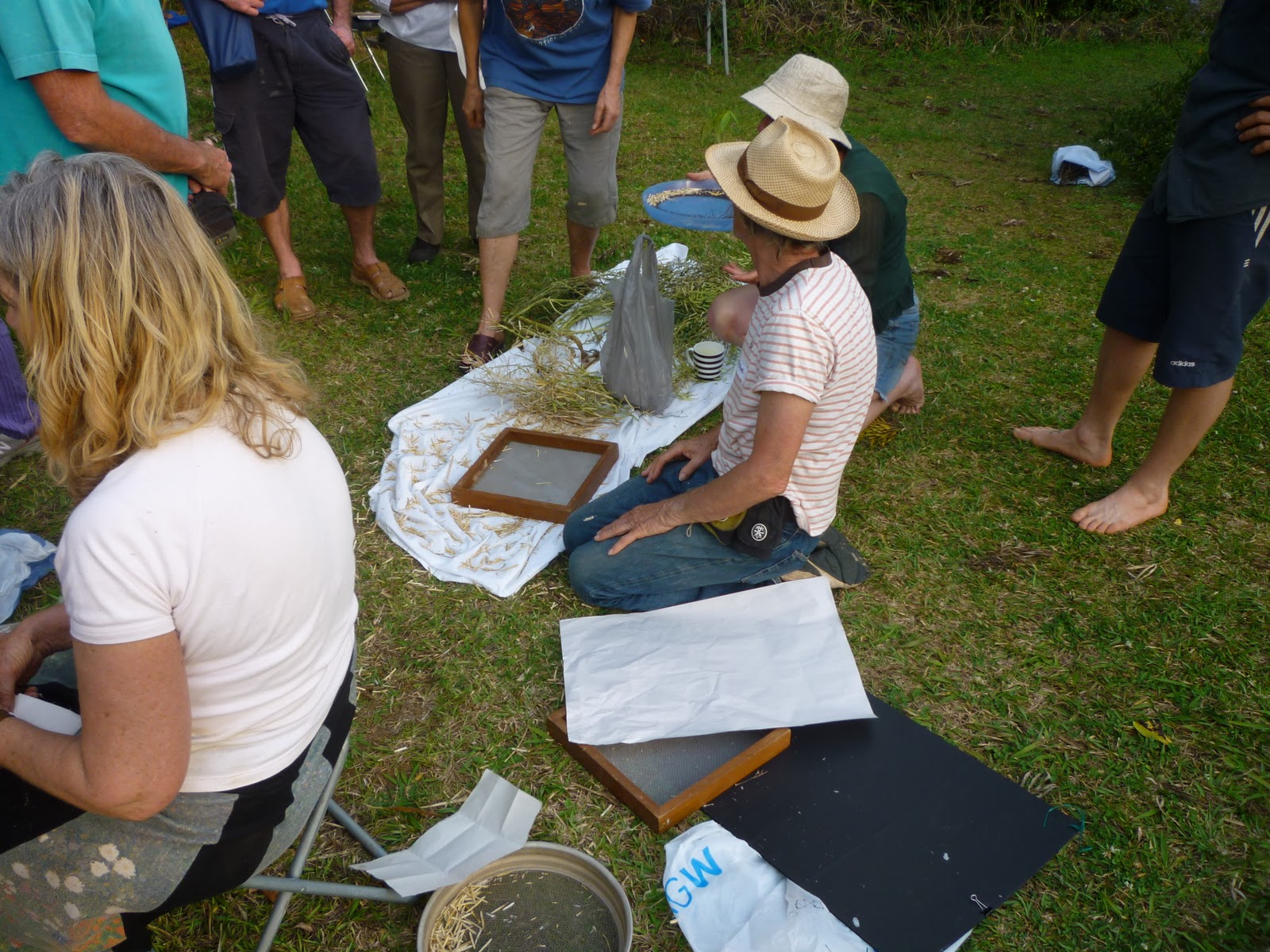
Seedsavers gathered to watch John and Allan demonstrate the making of Preparation 500, a biodynamic supplement.


A small amount of biodynamic preparation is vigorously swirled in the water for an hour before being sprinkled on the garden with a brush. Seedsavers are interested in many approaches to to increasing soil fertility and food production.


 Irene watches her organisation come to fruition.


 Artichokes thrive in our climate.


A young guava grows with fennel and yellow cosmos.
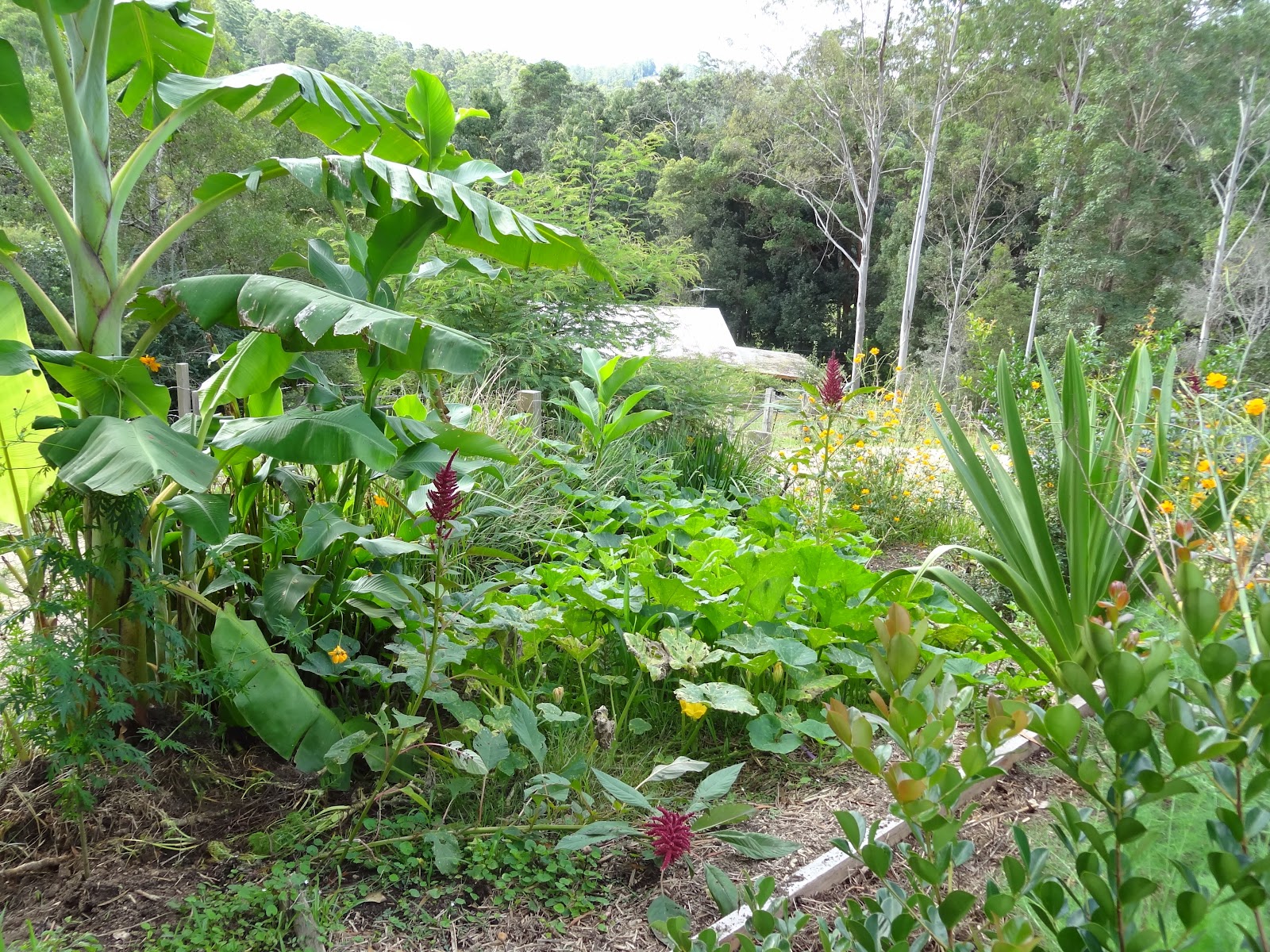
A young banana thrives with red flowering amaranthus.


Susan is hoping this young vanilla bean will thrive in this sheltered, sunny  position and survive the coming winter.


These young pullets did not mind the visitors. Some chickens were allowed to free range outside the fenced vegetable garden.


 Paw Paw growing in a herb bed near the house.


Cherry tomatoes love growing up through a wire tunnel.


A passionfruit spreads behind a bank of raspberries.


The fruit were large, juicy and ripe for picking.


One observer wondered what all the excitement was about.


Small hot chilis will keep this small family well supplied.


This bed of young carrots will produce a bumper crop.

A bed of greens with a sage plant


The seed table was a busy with collectors gathering dwarf Persimmon, sprouting Saba nuts, large white guava and candlenut. There were also hot chilis, Melastoma affine, Chinese Celery, Cosmos, Red Russian Kale seedlings and Mother of Herb cuttings.

Note the information sheets designed to share the details of the seeds.


Graham shared his years of knowledge.

Recipes based on the harvest of this month, limes and pumpkin, will be posted soon.

Susan and Em have certainly achieved their goal of combining beauty and food production. What a memorable house and garden!

P.S. Michael and Jodi added a healthy baby boy to their garden while we were gathering. Congratulations.




Friday, 20 April 2012

Gluten Free Moist Date Cake


This recipe is adapted from a ‘regular’ recipe. The original recipe listed 1 1/2 cups of self raising flour and 1/4cup plain flour.

Internet search revealed the recommendation to mix almond flour with other flours to replace the total amount of white flour in baking. I don’t think my calculations are absolutely exact but the ‘mix’ worked! Guar Gum is available at Kombu, health food stores and some supermarkets. It replaces gluten’s elasticity and the 1/2 teaspoon seemed to be right for this combination of flours.


Ingredients:
500g pitted dates
1 cup water
1/4 cup (good couple of ‘glugs’ of marsala)
1/2 teaspoon bicarb soda
185 g butter
2/3 cup caster sugar
3 eggs
3/4 cup fine almond meal
1/2 cup rice flour
1/4 cup maize flour
1/2 teaspoon guar gum (looks like a flour not a gum)

Method:
Combine dates, water, marsala and soda in bowl, stand overnight. Mash well before using.

Grease a 19cm square cake pan,line base and grease well.

Cream butter and sugar in small bowl until light and fluffy. Beat in eggs one at a time, beating until combined.

Transfer to large bowl. Stir in half sifted flour mixture and half undrained date mixture. Stir in remaining flour mixture and date mixture.

Bake in a moderate over for about 1 and1/4 hours. Stand 5 minutes before turning on to wire rack to cool.

Enjoy - Carol V.

Wednesday, 18 April 2012

Local News


Biodynamics Agriculture Australia Ltd  - "Biodynamics in the Home Garden" course at Brierfield on Friday 27 April 2012 for details click on BAA course


Mid North Coast Organics is organising a visit to an interesting Bush Food Orchard near Kempsey on Saturday 28 April for details click on Bush Food Orchard


'Save Our Seeds'


The May/June issue of 'Organic Gardener' magazine has an article by Simon Webster reporting on 'how industrial agriculture has led to a dramatic erosion of the world's seed diversity and how we can fight back'. 
 
 The article refers to the fast rate of disappearing seeds -
 
 "In the century leading up to the year 2000, the world lost 75% of the genetic diversity of its agricultural crops".  
 
I urge you to read the article,which includes alarming statistics about ownership of seeds,  and you will see that it includes a photo of Bellingen Seed Savers hard at work identifying seeds. 

Sunday, 8 April 2012

Bellingen Seedsavers visit Jodie and Michael on the Dorrigo plains.

Click on a pic to see all the pics in full screen.


We first called at the 'planet dorrigo' mountaintop nursery at 163 Maynard Plains Road, Dorrigo.   www.theplantsource.com.au
Steve answers our questions.


Here Steve Sutton has some beautiful plants at excellent prices in arguably one of the most scenic settings for a nursery in Australia. Most of us were interested in the plants that would survive in our coastal conditions but of course Steve also stocked plants for his locality, plants that tolerate frosts and sleet. We came away with a leucothoe plant, with gold variegated leaves, some abelias with dark red autumnal tones and a new salvia to add to the collection of bee attracting plants.


On arrival at Michael and Jodie's house we were again impressed by the setting.

In eighteen months they have created a flourishing vegetable garden well serviced by chook tractors. Here is how Michael and Jodi describe their garden.


"Our garden is quite young (about 18 months) but we have managed to be reasonably prolific in that time! The main part of the garden is vegetables (annual and perennial) in contoured beds. These are very close to the house thus should be fine for access. We also use chickens/ducks/geese rotated through some of the garden beds in a bird netted area and have the hothouse/seedling area. We also have goats (great for manure close at hand), Dexter cattle, alpacas and a horse.
View from Michael and Jodi's front door
Slightly further on we have an orchard that we are establishing below the house (this is a steeper walk to get up and down to), an area of large tobacco trees that we are experimenting with using to nurse-maid some sub tropical trees to develop a "food forest". The garden is constantly expanding as we are in the process of expanding to market gardening to sell a mixture of produce. Overall a mix of "a beautiful mess" and more conventional row style gardening!


The greenhouse is essential because of the cold tablelands climate.


Growing Chinese Waterchestnut in a container prevents this plant from becoming a water weed and makes harvesting much easier.


Parsley is flourishing on the tableland but is struggling in the coastal humidity.


Kang Kong grows well in the balmy summer but will soon succumb to frost.

Michael and Jodi have restored this chaff cutter to cut mulch.

 This fence of mixed berries is temporary. They will soon be transplanted to another area.

Jodie has imported a blocking tool that presses out a peat moss mix. Each block, large or small, becomes an individual seedbed and the plants can be transplanted with minimum disturbance of the roots.


This is the large blocking tool. Read more.


This chook dome is used to clear a patch of grass before planting.


A bed of asparagus and nasturtium is surrounded by rows of comfrey. Fertilising the asparagus with comfrey and nasturtium is therefore convenient.


Globe artichokes love the climate.


These yam bean dipping sticks were cut from the large yam bean below.


This huge yam from a yam bean may have grown over two summers. Unlike potato or apple it will not quickly oxidise when cut and exposed to the air.


Nell's pineapple butter tarts were delicious.


These tasty kofta burgers were a savoury treat.


A yummy pumpkin and polenta cake. We certainly have a glut of pumpkins this season.


This moist gluten free date cake was also a hit.


These jelly palm fruits were thirst-quenching and the seed was then available for planting.


Sunday, 18 March 2012

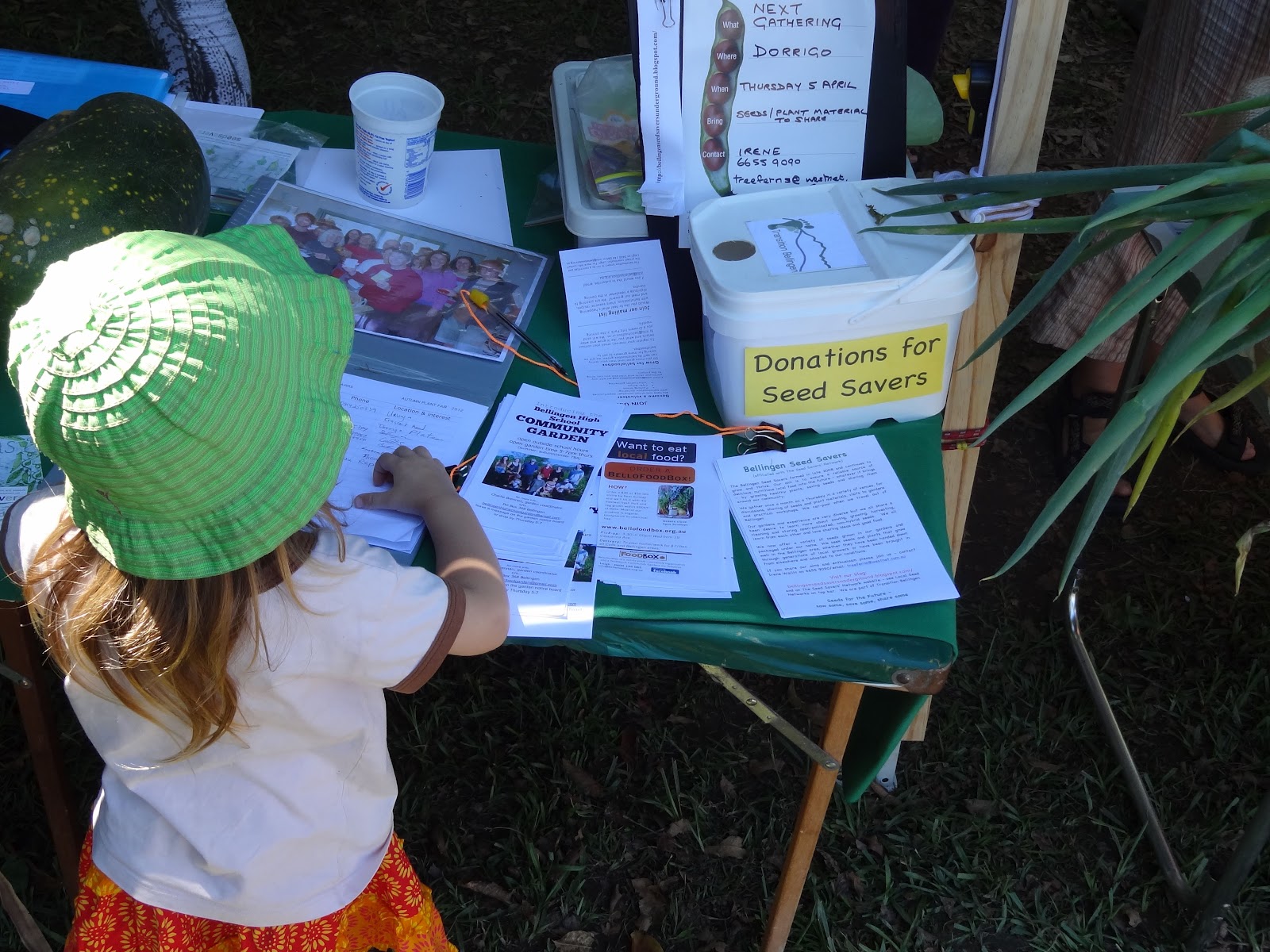
Bellingen Seedsavers at the Bellingen Plant Fair in March

A successful raffle of organic produce

Hi Seed Savers

Congratulations and huge thanks to everyone associated with our stall at the Plant Fair:  all the willing workers who participated in the seed-packing working bee;  propagated plant material and provided lovely home grown produce for the raffle prizes;  helped to set up the stall and the surrounding area and pack up at the end.  It was very satisfying to see the rather bare area when it was all over.  Hundreds of seeds are now in the hands and soil of the visitors, who I very much hope will "save some, sow some and share some".  The level of enthusiasm of visitors to the stall was overwhelming - it increases with each one. 

We will need to work hard to harvest seeds from our gardens to replenish our stocks for the Spring Plant Fair, so please save some of your best seeds for that purpose. 

Have you seen the kind words and great photos that Jude and Michele Fanton have on their website about their visit in September? :  http://www.seedsavers.net/seed-blog/workshops-bellingen-seed-savers-september-2011.  Cheers Irene

Busy, busy,busy


Click a pic to view pics in a slide show
A list of available seeds packaged by Bellingen Seedsavers


Some of the available plants


We appeal to all ages


A closer shot of the produce


More plants


More customers and staff


Bellingen High School Community Garden  holds working bees each Thursday 5pm. Details available at: working bees  


Siddhanta Hazell, teacher of Organics and Horticulture at TAFE for the last 10 years, will be offering free fruit and vegetable gardening advice at the Bellingen High School community garden on Thursdays from 5-6pm. People can bring their pests and diseases, their soil samples, their weeds, their worries, whatever. This service is part of the Garden's weekly gardening time for the general public, when you can get hands-on and dirty with garden tasks if you so desire or just wander and harvest and enjoy the burgeoning garden.Tools and equipment and tea making facilities available. The Garden entrance is off Crown St. See you there!


Food Exchange - Permaculture Collective MNC
10.30-12.30 Thursday 29 March - Church Street, outside Kombu (and alternate Thursdays)

Bellingen Seed Savers at Autumn Plant Fair 2012

Bellingen Seed Savers enjoyed another successful Plant Fair on Saturday 10 March - with huge interest from the public, perfect weather and many plants and seeds shared with our community.  Many thanks to all our members who worked on and before the day and/or, donated their plants, seeds and produce for the ever popular raffle.


Saturday, 25 February 2012

Perennial Staple Crops of the World

Coppiced mulberry leaf on contour at Las Cañadas for human food and
goat fodder. Overstory of nitrogen-fixing acacias.


Perennial Staple Crops of the World

This is a link to a website with some very useful information about some of the food crops we can or may be able to grow in our Bellingen locality.

Here is a tiny sample of this extensive information source.

Chaya/Tree Spinach (Cnidoscolus chayamansa), or Mayan spinach, is a shrub of the tropics and subtropics. It tolerates arid to humid conditions, in lowlands and highlands. Though raw leaves contain cyanide, the cooked leaves are very nutritious. Yields are very high, 20-30 tons per hectare fresh.

Katuk/Sweetleaf (Sauropus androgynous) is an Asian shrub with delicious leaves. Unlike most woody leaf crops it can be eaten raw. It likes humid tropical lowlands and thrives in the shade of fruit and nut crops. The protein content of fresh leaves is 6-10%.

Moringa/Drumstick Tree (Moringa oleifera, M. stenopetala) is a small tree of the tropics, thriving in arid and humid climates. The dried leaf is incredible nutritious, and used by nursing mothers in much of the tropics. If allowed to grow to tree form moringa produces nutritious pods, but for leaf production it is coppiced. Yields of moringa leaf are very high, 10-50 tons per hectare.

See also  SurvivalGardener.com

LinkWithin


Related Posts Plugin for WordPress, Blogger...

LinkWithin

Related Posts Plugin for WordPress, Blogger...