About Bellingen Seedsavers

We are a group of like-minded growers of edible and useful heritage plant varieties in the Bellingen area of northeast New South Wales, Australia.

Our climate varies from frost-free coastal areas to inland river valleys and highlands with frosts. Bellingen has an average annual rainfall of 1507ml.

Tuesday, 8 October 2019

Newsletter, October 201


News

Seed packing

Thank you to Gillian for generously hosting the seed packing for the Spring Plant Fair.

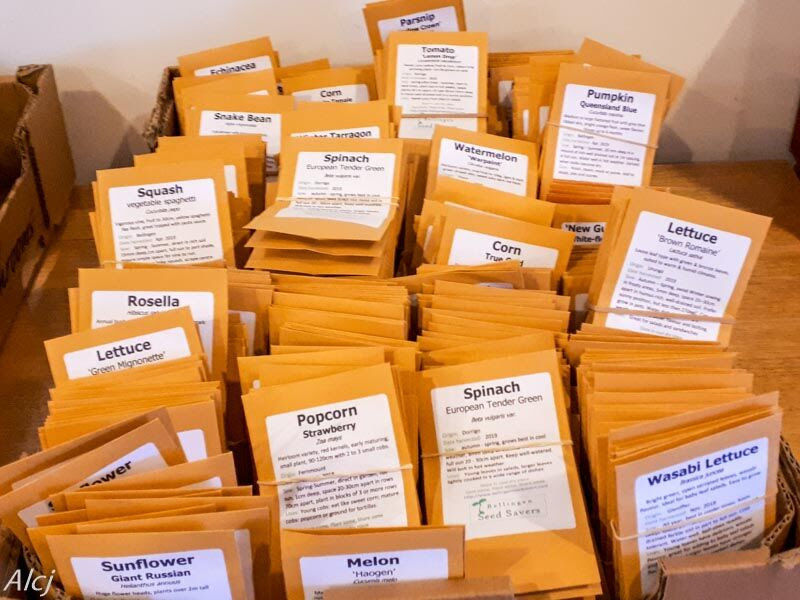
A team of 12 happy hard working volunteers made a fun time of packing approximately 600 packets of seed.

Thank you to all who donated seed and / or helped clean and pack.

John and Carol's food forest

Fourteen people visited John and Carol's garden in Fernmount, including some new faces (welcome and we hope to see you again). We started with some chit chat before starting on the best lunch in town. The hosts had prepared a couple of beautiful curries with rice and the guests supplemented those with a range of savoury and sweet dishes.
After lunch John took us on a tour of their well established food forest. We started at the front of the house with it's well established large shrubs. At the side of the house we passed some garden beds mainly used for perennial vegetables. The property was well screened from the neighbouring house with some big stands of various.

Next we went on a loop walk through the main food forest at the back of the house. There were a large variety of exotic trees and more common fruit trees, plus lower layers. As we toured the garden there were many stop and try points, where we sampled the produce. Examples of tasting included, sweet leaf, cape gooseberries, Australian sweet limes and some herbs. John showed how he has handled drainage on their fairly steep block. There was a mountain of citrus waiting to be harvested. The garden was obviously attractive to fruit eaters based on us finding a flying fox sheltering in one of the trees.

At the end of the tour there was plenty of stuff to be taken from the sharing table. John and Carol also generously offered people could take grapefruit, mandarins or sweet limes. Thanks for hosting a very enjoyable afternoon.

Seed labelling

After the enjoyable stroll around the food forest, everyone decided to stay on to label the 600 packets of seeds ready for the plant fair. Many hands made light work and the time passed quickly with plenty of chatter around each table.

For those people unfamiliar with the seed packing and seed labelling in preparation for the plant fair, there is a good reason that they are done on separate days. At the seed packing day, we start with a collection of seeds and many others arrive on the day. The seeds are then cleaned and packed into sale size lots in ziplock bags. At the start of the day we do not know all of the seed varieties we will get, let alone how many packets of each. Enter Jeff! After the seed packing day, Jeff takes away all of the packed seeds and compares them to our inventory and previous sale records and decides how many of each seed lot we are likely to sell. Next he prints out several hundred labels and gets everything well organised, so that on the labelling datings run like clockwork.

Thanks to Carol and John for hosting the seed labelling, Jeff for organising and the volunteers.

Spring plant fair

Pleasant weather contributed to a very busy and successful plant fair. We distributed our entire range of plant material, over half of our stock of seed packets and a bundle of Seed Savers books.

Our range of perennial herbs, fruits and vegetables were very popular, including: Yacon (thanks to the tasting samples), Okinawa & Longevity spinach, Chaya spinach tree, Surinam spinach, Hibiscus spinach tree, Aloe Vera, red sugar cane, strawberries, lemon grass, pomelo and ginger.

Popular seed packets included: sweet basil, Thai basil, butter beans, various types of snake bean, coriander, climbing spinach (Basella), true-gold sweet corn, echinacea, elderberry, Florence fennel, pineapple gooseberry, African marigolds, Italian parsley, New Guinea gourd, red & blue popcorn, pumpkin (5 varieties), rockmelon, rosella, tamarillo, tarragon, Lemon-drop tomato, Thai pink tomato, and 3 varieties of watermelon.
As always, an event such as this can-not go ahead without a huge amount of work by volunteers. I'm sure I'll miss some people, but the list of volunteers includes Jeff for overseeing all of the work getting our seeds together (he does a lot of the work as well). The people who donated seed, cutting and seedlings. The people who attended the seed packing and labelling sessions. Gillian for hosting the seed packing session and coordinating the plant fair. John and Carol for hosting the seed labelling session. Finally, the volunteers who set up,  worked on and packed up the plant fair stall: Tim, John, Gillian, Susan, Jeff, Leela, Debbie, Chris, Gabi, Nick, Fran and Barbara.

Diary Dates

Garden visit to Debbie's in Brierfield

SATURDAY 26th of October, 9:30 am - 12:00pm

Remember to seek out the sign-in sheet on arrival. 
Please bring a snack plate to contribute to our quick shared brunch
If you have them:
Please bring seeds or cuttings to share.

The Wild Pollinator Count (WPC) https://wildpollinatorcount.com/ is coming up next month (10-17 November) and is a citizen science project run out of the University of New England. The aims of the WPC are to collect information on which native insects are important pollinators in crops and gardens around the country.  Everyone has seen the European Honey Bee in action, however many native insects also contribute to pollination services.
Research is lacking on the identification of native pollinators, their habits and how they are affected by human activities.  The WPC provides an opportunity to contribute to the conservation of wild pollinating insects in Australia.

In order to encourage participation in the WPC by Bellingen Seed Saver (BSS) members we will be having a “dry run” on the identification and counting of native pollinators in our area.  This will involve a visit to member (and entomologist) Debbie Kent’s property at Brierfield on the morning of Saturday 26th October.  We will be hoping for a fine sunny morning to learn about the project by observation in Debbie’s native garden, vegetable and orchard areas.
Coming? please click here to RSVP, to obtain the address and so we know who’s attending. Please RSVP even if you already know how to get there.

Organiser: Lisa O'Callaghan / gardenvisits@bellingenseedsavers.comor phone 0417 536 490

Seed & Plant Swaps

Are you looking for particular seeds or plants? Do you have an abundance of something to give away? 
Email in to news@bellingenseedsavers.com for your search or offer to be put in the newsletter in this section.

Acknowledgements

Thanks to Jeff for the photos and plant fair writeup.
Thanks to Leela for assistance with content and newsletter outline.

SEED SAVING DETAILS 
When donating or sharing seeds, please email in the seed information so we know what we have (click the link, the email has the questions ready to fill out)
Email: seeds@bellingenseedsavers.com

Or fill in this PDF form. You will need Adobe Acrobat Reader to fill this out digitally. Remember to save each seed info as a separately named file!
Or print it out and fill it in by hand. 

Check out the Bellingen Seed Savers blog for recipes, local growing information, Diary Dates and garden visit photos.

Bellingen Seed Savers Chatter is our Facebook group where we can talk and talk and talk on all things seed savers and edible gardening.

www.BellingenSeedSavers.com is our website.

Saturday, 14 September 2019

At the Bellingen Spring Plant Fair

A selection of pics to show the interest Bellingen Seed Savers receives at the Plant Fair.We always welcome your support as staff or as customers at our stall. You can also sign up to receive a newsletter at our stalls.


Click to enlarge seed packets


Getting ready for sales.

Tuesday, 20 August 2019

Garden Visit to the Fernmount Food Forest, August 25


Lunch at 1.00PM, Sunday, August 25

Go to Fernmount Food Forest Blog

The Lunch and Garden Tour is followed by seed labelling by those who can remain to label.

Remember to seek out the sign-in sheet on arrival. 
Please bring a plate to contribute to our shared lunch
Bring seeds and excess plants to share if you have any.

This is an eleven year old food forest with subtropical and warm temperate fruit trees, nut trees and subtropical perennial vegetables.

Go to Fernmount Food Forest Blog

The garden/home orchard/food forest has been designed using permaculture principles. 

Close to the house (in Zone 1) there are raised beds for growing subtropical, perennial, green, vegetables:
 Surinam Spinach, Malabar Spinach, Okinawa Spinach, Warrigal Greens, Perennial Capsicum, Chaya Spinach Tree, Stevia, Longevity Spinach. Herbs such as Rosemary, Thyme, Lemon Balm and Chives are scattered near the house.


Annual Leaf Amaranth and Perennial Shallots, Pineapples, Olives, Blueberries and Onions are also growing in Zone 1


Also in Zone 1 are Persimmon, Bamboo (edible shoots) Olives, Pineapples, a Forest Pansy (edible flowers), Blueberries and Nasturtiums.

Go to Fernmount Food Forest Blog


Down the main path (Zone 2) there are some terraced gardens with beans, yam bean, rocket, leaf amaranth, garlic chives and perennial onions presently flourishing.


Zone 3 has fruit and nut trees. The variety of trees in various microclimates and the number of species provides a constant food harvest rather than a glut of fruit at any one harvest period. 

The area above the main path has 300 square metres of drip irrigation fed by pump-out from the ‘worm inoculated’ waste system. That area has a huge range of citrus trees (oranges, blood oranges, mandarins, kumquats, kaffir lime, limes, sweet limes, grapefruit, lemonade, finger limes)  as well as Cavendish and Lady Finger Bananas, Custard Apples, Kiwi Fruit, Black Sapote, Pomegranate, Dragon Fruit, Kwai Muk, Wax Jambu, Soursop, Macadamia Nuts and Pecan Trees.


Below the wide, main path (designed for vehicle use if necessary) is an intensively planted variety of fruit and nut trees including Star Fruit, Custard Apples, Rollinia, Cherimoya, Apples (on the colder lower slope), Peaches, Nectarines, Japanese Plums, Davidson Plum, Herbert River Cherry, Blue Java Banana, Choko, Tamarillos, Mamey Sapote, Abiu, Amla, Jack Fruit, Pitomba and Avocado.


A small dam serves as a water resource backup if required. The dam and nearby native trees provide a haven for insect eating birds (Zone 4).  Throughout the garden salvias and other plants also attract bees and birds. Plants are specifically grown for cut and drop mulch including, salvias, Vetiver Grass and Tithonia. A hive of native bees (behind the useful steel shed) assists with pollination.


Seven taps are connected to the pressure pump on the 22 500 L rainwater tank (with an option for town water top-up when required) and a mains pressure tap is sited at the water meter.

Coming? RSVP to obtain the address and so we know who’s attending, even if you already know how to get there.

Organiser: Leela O'Callaghan gardenvisits@bellingenseedsavers.com


Seed packing at Gillians, August 17


When seed packing it's always a pleasure to discover some interesting additions to our range of seeds, like the Peruvian Polenta Corn that is used for tortillas and the African cucurbits. 


We are going to have our best ever range of saved seeds for the September 14th Spring Plant Fair in Bellingen. 


 We always have plenty of growing news, as well as other news, to share; and of course we always bring plenty of finger food to share as well.

Packing New Guinea Bean.
 Seed Saver Fiona produced a huge crop of New Guinea Beans this year. It is well worth growing in our climate.


"From time to time I'm asked, 'What can I grow in the vegie patch that's a bit different?' Well this is definitely different."

"This is a New Guinea Bean (Lagenaria siceraria), which ironically is neither from New Guinea - it's actually from Africa - and it's not even a bean! It's actually a climbing edible gourd or squash - a member of the cucurbit family."

"If you let them grow as big as they want to, they'll get to a metre plus long and five kilograms. However, if you want to eat them as a vegetable, you harvest them anywhere from around 30 to 60 centimetres long."

"Their flesh, if you eat it raw, tastes like a cross between zucchini and cucumber - nicer than raw zucchini. They can be cooked for all sorts of things - we made a delicious cake out of it - better than any carrot cake you've tasted!"

"The thing I love about the New Guinea Bean is that it's so vigorous. Last year, it actually covered the whole of one of my arbours and created a great amount of shade. I was late getting it in this year, so it's not going to get quite as big, but I can still get some beautiful beans off it before the frost nibbles at the foliage and causes it to die off for me."

"If you live in the tropics and you have trouble growing normal beans because of fungal diseases, this will absolutely love the conditions. So, if you like things unusual, give a New Guinea Bean a shot in your vegie patch!"   From ABC Plant Profile 

 
Cleaning seed

Packed seeds ready for labelling
On Sunday, August 25th, we will be labelling seeds at John and Carol's after a shared lunch and a garden tour at their Fernmount Food Forest. The visit is open to all interested in sharing seeds and growing them for food production.

Wednesday, 7 August 2019

Flowering and Fruiting in a Bellinger River Valley Garden in Early August

Despite that it is still the first week of August it is very early Spring on the Coffs Coast. In the Fernmount Food Forest fruit trees are bursting into flower if they are receiving some northern sun.

Amaranth
 All through Winter self-sown Amaranth plants have thrived in a sunny spot.

Seedling Black Sapote (Pic by Peter Hardinge)
 This seedling Black Sapote is covered in fruit this year.


Mandarins and Lemons (Pic by Peter Hardinge)
We are suffering some insect damage but the citrus fruit is still abundant and juicy.


Dwarf White Peach


Monday, 5 August 2019

What are Heirloom, Hybrid and GMO Vegetable Seeds and More?: Video

In this video John will ask Jere many questions about seeds including what is an heirloom seed? What is a hybrid seed? and What is a GMO seed? and much, much more.


Learn Organic Gardening at GrowingYourGreens


John from http://www.growingyourgreens.com/ interviews Jere Gettle, seed collector and founder of Baker Creek Heirloom Seeds.

In this episode, you will learn the question to the following answers:
 01:10 Why did you Start Selling Heirloom Seeds and How old were you?
02:00 What is an Heirloom Seed?
02:52 Is there a minimum age needed to call something an Heirloom?
03:39 Why Grow Heirloom Herbs, Vegetables and Fruits?
04:52 Do you explain where heirloom seeds were grown in your seed catalog? Why is it important? 06:57 What is a Hybrid Seed / Vegetable ?
09:07 Is it true that if you grow a hybrid for 6 generations will the seed stabilize?
10:21 Should you never grow a hybrid vegetable from seed?
11:49 What is a GMO Seed and Vegetable?
14:22 What is an open pollinated Plant?
15:36 Are all heirlooms organic?
23:00 Why is it important for people to save their own seeds?
24:16 What is the best way to store your seeds?
26:17 What are new seeds that Baker Creek will introduce soon?
29:51 What are your thoughts on deeply pigmented vegetables?
31:40 What are some of the varieties of deeply pigmented vegetables you are bringing in?
33:05 Why did you start the National Heirloom Expo?
34:17 You have been described as a "hippy freak" what are your thoughts on this?
37:30 Why do you decide the eat a plant based diet why is it important to eat more plants?
41:45 How can someone by your heirloom seeds and get a free catalog?

Related:

Selecting Seeds: Heirloom vs Organic vs Hybrid vs GMO

Saturday, 20 July 2019

Garden Visit to Tim’s new Food Forest in Fernmount


There was more than met the eye in this new Fernmount garden:

Tim and his growing family have been living in what was a vacant block for just over two years now, some of you may be familiar with it as the former 'Secret Garden' nursery. Lots of planning, passion and effort has netted him a food forest, jumping out of the ground, out and proud, in the front yard. An unorthodox style, but then a little chaos always brings opportunity.

Kale
  Around the back there is more experimentation and innovation with livestock and microclimates; endless fun and education for his kids.


Tim tells us about his banana trees.
We learned Tim has recently gained an organic certification for his property. So he is careful what he feeds his livestock and where he uses his produced animal manure.

Friday, 19 July 2019

Sandies's Bean and Yoghurt Dip, adapted by Shann


500gm thick Greek style yoghurt (drain but not too much)
2 green chilies, seeds left in and finely chopped.
1/2 bunch mint, finely chopped
1/2 lemon. juiced
Sea salt and freshly cracked pepper
40 mls extra virgin olive oil
40-80mls extra virgin olive oil
Two 400gm cans of butter beans, drained and rinsed.

Method:
Combine yoghurt, chili, mint and lemon juice in a bowl.
Season with salt and pepper and stir though the oil.
Using remaining olive oil fry the beans over medium heat for a few minutes or until skins begin to split.
Season with salt, add garlic and cook for 3 minutes until golden.

Stir though paprika.

Pour yoghurt mixture onto a plate and make a well. Spoon in the bean mix

Note: Adapt to taste says Shann
"Only add chili to taste. I mash the beans leaving some small hunks. 
I use less oil in the yoghurt.
I retain some of the bean can liquid in case they mash too dry."

Sunday, 7 July 2019

Cooked greens with sweet banana porridge

Cooked greens with sweet banana porridge
This is an easy recipe that adds more green vegetables to your breakfast.

It also makes a useful meal at other times with different vegetables and sweeteners added.

Chop a cup of mixed greens that do not require extensive cooking to remove any toxins, such as Okinawa Spinach, Malabar Spinach, Leaf Amaranth, Longevity Spinach, Silver Beet and Spinach.

OR 

Cook chopped greens that do require cooking to remove toxins such as Chaya, Cassava leaves, Taro leaves. 

Add to a microwave bowl with a cup of porridge oats (I prefer traditional oats rather than quick oats)  finely sliced banana, milk, and your preferred sweetener if desired. 

Microwave until the oats are cooked, around 3 minutes.  Enjoy.

................................

Experiment cooking greens into polenta and maize flour.

Related:

Growing and eating Malabar Spinach (Ceylon Spinach)


Okinawa Spinach Growing Information

This tasty vegetable grows very easily in the Bellingen Valley. It is a little cold sensitive. Protect from frosts.  Share cuttings with friends.
Green Harvest has plants.


From the Green Harvest catalogue 

© Frances Michaels

BOTANICAL NAME:Gynura crepioides
COMMON NAMES: Okinawa spinach, Hong tsoi, Okinawa lettuce
FAMILY: Asteraceae
ORIGIN: Native to Indonesia

PLANT DESCRIPTION
Okinawa Spinach is a dense, low growing plant to 70 cm high. Easily the most low maintenance perennial leaf vegetable; it is a hardy plant and relatively pest-free. Thriving in warm, wet conditions Okinawa Spinach does best in subtropical and tropical areas; it is sensitive to frost. An attractive plant with shiny leaves that are green on top and purple underneath; the flowers are very small and orange. It grows best in full sun to partial shade. It needs ample water, rich, fertile well-drained soil that is kept mulched and prefers a pH of between 6.1 and 6.5.

USES

  • Food: It is a very nutritious vegetable, eaten raw or cooked. The leaves and young shoot tips are steamed, used in stir fry, tempura, stews, and soups. Try not to overcook it as it can become slimy. The leaves have a crisp, nutty taste with a faint hint of pine. In Okinawa the leaves are often fried and served as tempura. It can also be steamed with rice if it is added for the last 7 minutes of cooking time. This leafy green is also known as cholesterol spinach, and there are many claims that it lowers cholesterol. Young leaves have a much better flavour than the older leaves.
  • Edible Landscaping: The vivid leaf colour makes this a good choice as a background plant in ornamental beds. Okinawa Spinach can be used in landscaping as a groundcover in full sun (with enough water) or it does well in partial shade. It is very adaptable to container gardening and hanging baskets and will grow inside on a windowsill with good light.
PLANTING DETAILS
  • Recommended Planting Time: Cuttings are best taken when the soil temperature is at least 25°C. Rooting the cutting in water before planting will improve results. The plant responds well to pruning, rapidly becoming bushy. Pruning also prolongs its life.
  • Planting Depth: Cuttings 10 - 20 cm long should be half buried in potting mix and kept moist.
  • Spacing: Space plants at 60 cm apart.
Recipes from The Edible Plant Project :

Okinawa Spinach
Okinawa Spinach with Rice & Mango
Okinawa Spinach
& Grits


Thursday, 4 July 2019

Growing and eating Malabar Spinach (Ceylon Spinach)

Basella alba is another subtropical vegetable for growing in the Bellinger Valley.


Published on Oct 30, 2016
In today's episode we look at how to grow Malabar Spinach in a container. We look at everything you need to grow Malabar Spinach, from the soil selection to the fertilizer schedule to the harvest and saving seeds once the season is over. We also include a Malabar Spinach Fritters Recipe in this episode!

Note: Baking soda and bicarbonate of soda are the same thing. Gram is chickpea flour. Experiment with your own flour batter.


Video: Longevity Spinach - Gynura procumbens

We grow this scrumptious,  healthy vegetable so easily in our Bellinger Valley. Use it like spinach or chard.


Related:

Okinawa Spinach Growing Information

Thursday, 27 June 2019

SeedSavers Video: "Our Seeds - Why save seeds and who does it?"


This is just the first 3 mins of our 57 min documentary on traditional food plants, that we shot in eleven countries. 

We took all the footage and made it in our editing suite in Byron Bay, Australia in 2008. "Our Seeds" has been shown on television in ten Pacific nations and on cable television in Manhattan NY in January 2010. We offer DVDs of "Our Seeds" for sale and work papers at www.seedsavers.net. 

Welcome to The Seed Savers' Network of Australia The Seed Savers' Network is an Australian-based organisation established in 1986 to preserve local varieties of useful plants. There are more than eighty Local Seed Networks for local gardeners around Australia. We are also active in forty countries so far. 

Gardening Australia Seed Saving Fact Sheet with video link

SERIES 21 Episode 32

Mustard
Jerry says the most important seed saving rule is to save seeds from the best plants and to eat the rest. "It's important to only save seed from non-hybrid plants and these are commonly referred to as heritage, old-fashioned or open pollinated plants. They are the plants most likely to produce offspring - in the form of seed - that closely resemble their parents."

Watch the story

Saturday, 22 June 2019

June 22 Solstice visit to David's food forest in Gleniffer

Established over ten years David now has a forest with paths under the tree limbs. About 30 Seed Savers attended and enjoyed the relaxed stroll on the paths, the food, the chat and the seed/plant sharing.

"Thanks to the 27 members that came - quite the eclectic crowd. A 2nd, then 3rd table, added, groaning under the weight of earthly delights. Fortunate timing brought us glorious weather, to celebrate the shortest day that heralds lengthening ones to come. A group headed off to marvel at the latest goings on the garden, David full of wise musings and cheeky wit as usual.

Others mingled by the cheery fire, sharing tips and swapping yarns.  A wonderful winter's day.

David's garden had plenty of trees carrying fruit (see photos). He had enough citrus to make a small mountain. There were also at least three different nut trees that had fruited / nutted recently. There was a macadamia, a candle nut and a Bunya. David had been given the Bunya in a pot and it is now a very impressive specimen. A seedling under the tree was passed on to another member to raise the next generation. Another member present also has Bunyas that are dropping cones. He has successfully gone from seed to seed!"

Avocado

Red Grumichama

Pepino


Come on Dad.

David and Sandy consult.

David and Sandy consult. Don looks on.

Now what is that tree? Here is the bean pod.
It turned out to be

Black Bean, Moreton Bay Chestnut or

Castanospermum australe

Gillian digs some of David's strawberries

Chatting and eating around the log fire.

Monday, 10 June 2019

"Save Our Food. Free the Seed." : New York Times

These are a few excerpts from an article that spells out why we need to save our local seeds.

"The type of seed also dictates the fertilizer, pesticide and fungicide regimen, sold by the same company as part of the package, requiring a particular planter and sprayer (40 feet and 140 feet wide, respectively) and producing a per-acre yield that is startling, and startlingly easy to predict.
 

It is as if the seed is a toy that comes with a mile-long list of component parts you’re required to purchase to make it function properly.


We think that the behemoths of agribusiness known as Big Food control the food system from up high — distribution, processing and the marketplace muscling everything into position. But really it is the seed that determines the system, not the other way around."

"The seeds in my palm optimized the farm for large-scale machinery and chemical regimens; they reduced the need for labor; they elbowed out the competition (formally known as biodiversity). In other words, seeds are a blueprint for how we eat."

.......  
"We should be alarmed by the current architects.

Just 50 years ago, some 1,000 small and family-owned seed companies were producing and distributing seeds in the United States; by 2009, there were fewer than 100. Thanks to a series of mergers and acquisitions over the last few years, four multinational agrochemical firms — Corteva, ChemChina, Bayer and BASF — now control over 60 percent of global seed sales."
.......

"According to a report published by the Organic Seed Alliance, most large-scale organic crop acreage is planted with conventional seed. Despite a recent uptick in the production of organic seed, there isn’t enough to go around. “Not if you want to plant 200 acres,” one midsize organic farmer told me. “Not even if you want to plant 50 acres.”
 
Farmers find themselves hobbled by weak plants that were designed to be weaned on chemicals.

It’s not hard to see why organic food is expensive. Farmers have to price the organic carrots to reflect the cost of production in a world designed for them to fail. In the checkout aisle, we wince. A consensus is reached: Organic carrots are a noble idea but not a practical one to feed our growing population."

Tuesday, 4 June 2019

Vale Seed Saver David Wallin

Dear Seed Savers,

We are sorry to inform you of the sudden passing of David Wallin.
Irene Wallin, supported by David every step of the way, initially founded the Bellingen Seed Savers as part of Transition Bellingen. 


David and Irene were key people in our Seed Savers group until just a few years ago, when they had to become less involved due to declining health.
David Wallin at a Seed Savers stall


There will be drinks, nibbles and tall tales at the Old Butter Factory, this Thursday, June 6, 2:00-4:00pm to celebrate David's life. All who knew him are welcome.
David and Irene Wallin

Monday, 3 June 2019

Fruiting in the Bellinger Valley in late May.

A seed grown Pomegranate fruit
"The fruit mature between March and May (in Australia) and can be picked a little before full maturity and ripened in storage. In areas where rain occurs during harvest, pick the fruit before they are fully ripe to avoid the skin becoming waterlogged and splitting." Green Harvest

Perhaps this fruit, the first from this tree, should have been picked then left to ripen.

Tuesday, 28 May 2019

A Killer on our Streets, in our Yards and Bush: Bob The Beeman

African Tulip Tree

I wondered why our native bees were declining in our food forest. there are a number of African Tulip Trees nearby.

"The African Tulip Tree (Spathodea campanulata) is listed as a Class 3 pest by the DPI, and can no longer be sold or distributed in Qld. However its past history of distribution as a street and landscaping tree has ensured plentiful escapes into natural and urban habitats displaying the behaviour that justifies its inclusion in the Global Invasive Species Database “Top 100 World's Worst Invaders”.

Drive around most suburbs of Brisbane or other Queensland towns and the chances are you will see examples on the the footpath or in yards. Out in the countryside, its bright orange flowers stand out over the cooler months of the year.

Unfortunately if one takes the time to look closer, this beauty conceals a lethal threat to our stingless bees. Look at the sprays of flowers and you will see stingless bees attracted to the flowers for foraging. Look closer and you will see the bees gathering pollen, and seemingly imbibing other plant secretions as well as nectar. Unfortunately if you continue the examination into the flowers, you will find the result of that foraging for pollen and nectar, a collection of dead and dying stingless bees and other insects.

While I cannot say just what the chemical mechanism of the toxicity is, it seems to be quick, I have watched a bee in its death throes within the flower itself. I have collected many such specimens.

Information published in Brazil found that the gathered pollen did not get back to the hives, so the attracted bees are killed before they can return. Unfortunately the mechanism of attraction is strong and the numbers of stingless bees killed can be quite large in areas where stingless bees are present."

by Bob Luttrell, Bob the Beeman. (B Ag Sc)
www.bobthebeeman.com.au

Read the full article 


See also:

Three Seedsavers properties for sale in Bellingen area

Sunday, 26 May 2019

How Small Farms Can (Sustainably) Feed The Future

"Small farms farm better.

And large farms can’t.

Small farms are the best hope that we hold of feeding a future of 9 billion (and beyond). At the same time they hold the potential to redistribute wealth, conserve biodiversity, secure livelihoods for some of the world’s most marginalised and ensure a continuation of traditional cultural relationships with the land. They are truly our most sustainable option."

"Sustainable development in agriculture would ensure that the economic, social, environmental and cultural needs of present and future generations are met. Sustainable agriculture rests on these four pillars."

LinkWithin


Related Posts Plugin for WordPress, Blogger...

LinkWithin

Related Posts Plugin for WordPress, Blogger...