About Bellingen Seedsavers

We are a group of like-minded growers of edible and useful heritage plant varieties in the Bellingen area of northeast New South Wales, Australia.

Our climate varies from frost-free coastal areas to inland river valleys and highlands with frosts. Bellingen has an average annual rainfall of 1507ml.

Showing posts with label ginger. Show all posts

Monday, 21 November 2016

Charlie's subtropical garden at Thora.


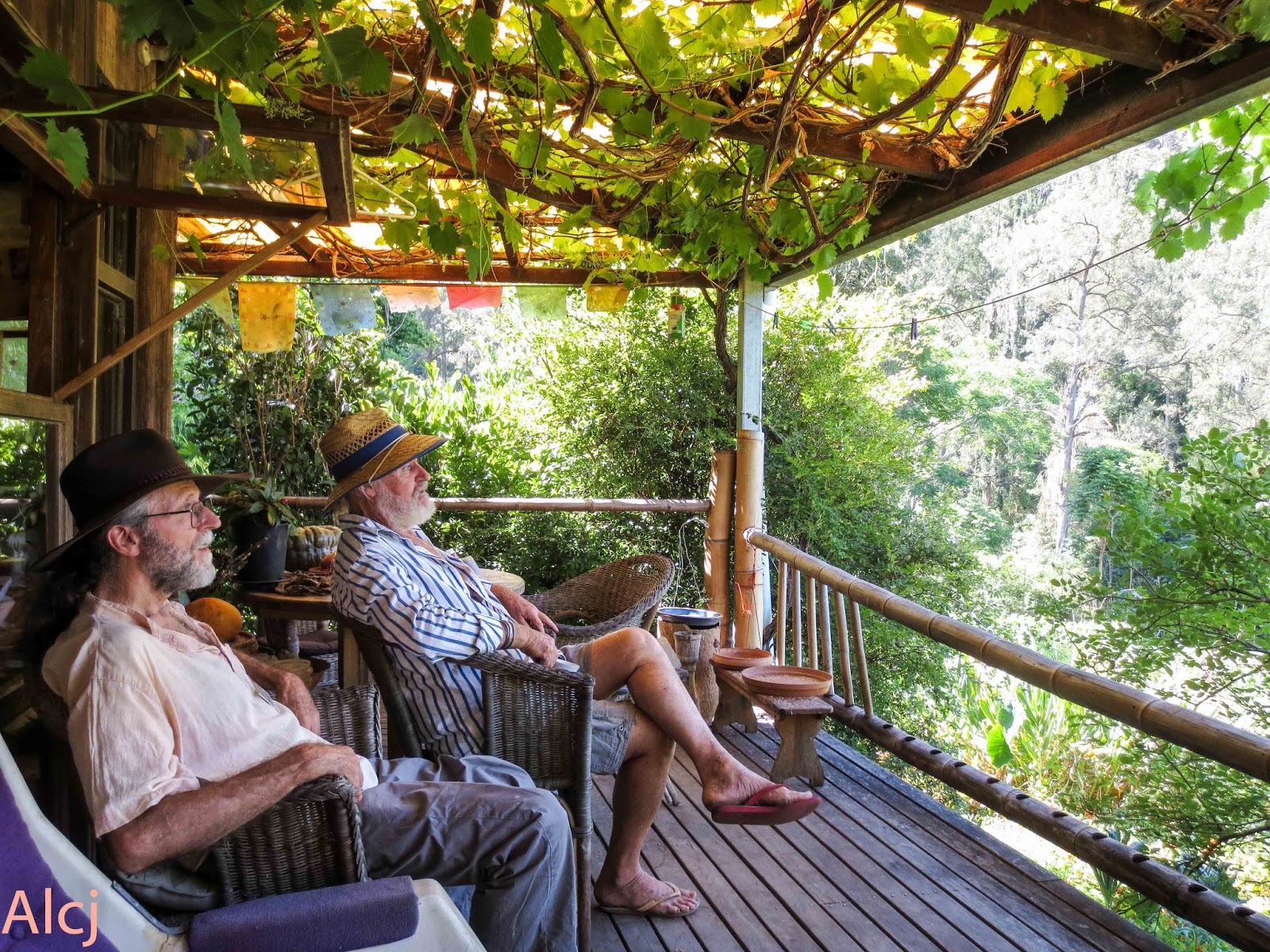
On Sunday 13th November we visited our friend Charlies' beautiful tropical gardens and home in Thora.

It is highly productive garden and Charlie very comfortably lives of this land. His daughter sells a lot of his produce (turmeric, ginger, nuts, fruit) at the markets in Newcastle to provide nourishment to the city people and to generate income. 


Charlie and Karin were fantastic hosts on this very warm summers day. Charlie has lived here since the seventies and raised his family here. His children have grown up and flown the coop, but  his garden and his impressive collections of productive and ornamental trees and plants have kept on growing and keep on feeding his extended family.


Charlie has created a series of garden rooms and continues to expand. He uses permaculture and biodynamic principles and does most of the work by hand. While walking us through the garden he talked us through what tasks he was going to do in the next few days… and it was a list so long that less driven and enthusiastic people would take at least a month to get anywhere close. It was an inspiring day in an inspiring garden.


We drank many cups of tea and ate healthy and delicious food, as always we swapped plant material and seeds and a lot of good growing advice. A great day, thank you Charlie and Karin!
Report by Erik



Wednesday, 27 January 2016

A walk around David's garden yesterday January 2016


Nell's bananas with enormous bunches are coming good and the birds haven't found them yet - must cover the bunches. Giant lettuce from the Community Gardens and chillis so hot I don't dare to touch them and the curry tree in flower. 


Irene and David's palms pushing up through the forest - strange spinach from John's garden looking good and even Aztec corn coming up now - that'll shade the lychee from the scorching sun. And Elizabeth's dahlias are everywhere now. 

So many plants, so much food, from so many different people - such a pleasure. Where each plant comes from, I don't always remember, but it's mostly from the seedsavers group so -  THANK YOU all.
 

And I'm sure the Great Mother thanks you too. 

by David P. 


Wednesday, 24 April 2013

RAE' S CARROT & GINGER WALNUT CAKE


This cake is a winner. It was moist and tasty. It's quick and easy to bake. We had the cake without the cream cheese frosting and it was still yummy.  It certainly was enjoyed at our last outing. We all grow ginger at home and macadamia nuts or pecans, which also grow locally, could also be substituted for the walnuts. Now I wonder if pineapple could be substituted, partly or fully, for the carrot?? What about sweet potato?? Add your comments below.

Ingredients

1 cup self raising flour
1tsp
bicarbonate of soda
1/2 tsp ground cinnamon
1/2 tspn ground cloves
1 cup brown sugar firmly packed
1 1/2 cups grated carrot
1/2 cup raisins
1/2 cup finely chopped Buderim Naked ginger
1/2 cup finely chopped walnuts


2/3 cup vegetable oil

2 eggs lightly beaten

Frosting

60g softened cream cheese

30g soft margerine

1 tsp finely grated lime rind (optional)

1tsp lime juice

1/1/2 cups icing sugar mix

Method 


Preheat oven to 160 degrees C
 

Grease 14cm x 25cm loaf pan, line base with paper, grease paper Sift flour, soda and spices into bowl
 

Stir in sugar, carrot, sultanas, ginger and nuts
 

Stir in combined oil and eggs
 

Beat on medium speed with electric mixer for 5 minutes
 

Pour into prepared pan
 

Bake at 160 degrees C for about 60 – 70 minutes
 

Stand 5 – 10 minutes before turning onto wire rack to cool

Cream Cheese Frosting:
 

Beat cream cheese, margarine and lime rind and juice in small bowl with electric mixer until smooth, gradually beat in sifted icing sugar. When cake is cold, spread with frosting and top with a few walnuts. 

Sunday, 21 April 2013

Garden visit to a developing food forest at Gleniffer

Click on a photo to enlarge.

Afternoon Tea in the garden
 We always have a sumptuous afternoon tea after our garden tour.
Afternoon Tea in Gleniffer

date & walnut cake


Pumpkin muffins; a great way to use pumpkin

Candlenut Tree
 We will post recipes in a later post.
Candlenut on the tree

Carambola Tree with fruit

Compost heap

Ginger patch
Every plant pictured grows well in our warm temperate/sub-tropical climate. Ginger (above) is very useful and loves our heat and water. You can start with a chunk from the greengrocer or market. Make sure each piece planted has an eye.

Hawaiian Guava

Lab Lab Bean and Elder flower

Mandarin


As we wended our path through the food forest we came across a huge flowering mandarin laden with fruit.

The Lab Lab bean grows along fencelines and trellises.
Mushrooms

These mushrooms sprang out of the horse manure David had collected.

Newly constructed path

Pineapple guava

Plant table

Pomello


Mushrooms growing from horse manure mulch


 Saba Nuts shoot underneath the tree
David's garden has grown so much since our last visit. He hopes to host a permaculture course with Rosemary Morrow later in the year.
Banana

Rhubarb is useful in desserts or in savoury stews.

Wednesday, 23 January 2013

Coconut Pumpkin Soup

We grow pumpkins and the other ingredients for this soup so easily in our climate. Click on the link for the recipe.


With our indigenous “pumpkin”, calabaza squash, in full season we buy a wedge every week and I try a new recipe. Epicurious.com has been a good source for recipes, some are great as is, and others, like this one, needed some tweaking. Here’s my version which turns out to be very much like those I had in South East Asia. Note that the roasting of the shallots is important for the flavour.

You could also try

Friday, 20 July 2012

Cooking Taro and Jicama (Yam Bean) Rolls & other Asian recipes

Taro plant

Yam Bean dip sticks
There are many vegetarian recipes on 'Nyonya Food' blog. This is an interesting recipe because it demonstrates how to use both Taro and Jicama(Yam Bean) in an interesting dish.


 Try also

Jiu Hu Char (Fried Jicama/Yambean with Shredded Cuttlefish)


Here is another blog recipe using Jicama sticks: The Skinny Confidential


Cassava


The same blog, Nyonya Food, also has a recipe for a Cassava Cake, another of our easily grown foods.


Delicieux's Asian Noodle Soup


This Asian Noodle soup (at Delicieux) blog uses many ingredients we grow, lime, ginger, coriander, lemongrass and chili.

Saturday, 21 January 2012

January Fruiting in the Bellingen Area

Here are a few of the plants fruiting in this area at this time.

 This White Sapote has yielded a few fruit and as you can see there are more on the way as they seem to ripen over a few months. Bagging against fruit fly is necessary.

The cucumbers are at their most productive.
 Black Kale (Dino Kale, Cavallo Nero) are still producing fresh leaves although the older leaves are well nibbled by the white cabbage moth.

Keeping the birds away from the ripening grapes can be a chore.
 These Perennial Capsicums are small but prolific at a time when capsicums can be quite costly.

Rhubarb does not like much heat but the weather has been more wet and humid than hot and sunny.

It is time to dig the Cassava.
 The bush Butter Beans are adding to the climbing beans and Snake Beans which have been producing since Christmas.
 This Cranberry Hibiscus was a surprise seedling. A few young leaves added to the salad bowl taste like sorrel, contributing a slight lemony flavour.
At present this Mountain Paw Paw drops its fruit before they reach a useful size.


This Wax Jambu is producing loads of crisp, crunchy, moist fruit. These are great to eat fresh but not to everyones taste. Wax Jambu would really contribute to an asian salad with a lime juice dressing.


 This tamarillo has been fruiting for a month. If grilled, like a tomato,  a Tamarillo will add flavour to the breakfast plate.

The first of the Wing Beans are ready to pick before they become too big and full of fibre. These plants have regrown from the 2010, 2011 tubers.
This is a moth eaten leaf but the tiny sprouts of Purple Sprouting Broccoli are still being produced.
 The sweet basil loves the humid warm weather.
 The New Guinean Mushroom plant also likes some rain, heat and shade.

 The ginger has been shooting for six weeks now. It loves this weather and is growing in shade beneath the Tiger Grass.
 The unblanched celery is tough but softens when cooked.
The Snake Beans love the heat. Why do they attract so many ants? Picking each bean with a twist, so the growing point will fruit again, has contributed to the yield.  What is fruiting in your garden at this time?

LinkWithin


Related Posts Plugin for WordPress, Blogger...

LinkWithin

Related Posts Plugin for WordPress, Blogger...