About Bellingen Seedsavers

We are a group of like-minded growers of edible and useful heritage plant varieties in the Bellingen area of northeast New South Wales, Australia.

Our climate varies from frost-free coastal areas to inland river valleys and highlands with frosts. Bellingen has an average annual rainfall of 1507ml.

Wednesday, 23 January 2013

Using Rosella - A Christmas drink!!

We grow edible hibiscus, Cranberry Hibiscus and Rosella/Roselle (Hibiscus sabdiffera) very easily in our climate. Here is a use for the sepals from the flowers of the Rosella.

Click on the link for the recipe.


The red sepals of the Roselle plant (Hibiscus sabdariffa) is commonly called sorrel in the Caribbean. The young leaves are great in salads, with a sour taste very similar to sorrel (Rumex acetosa), the vegetable of European origin (hence the common name.

Coconut Pumpkin Soup

We grow pumpkins and the other ingredients for this soup so easily in our climate. Click on the link for the recipe.


With our indigenous “pumpkin”, calabaza squash, in full season we buy a wedge every week and I try a new recipe. Epicurious.com has been a good source for recipes, some are great as is, and others, like this one, needed some tweaking. Here’s my version which turns out to be very much like those I had in South East Asia. Note that the roasting of the shallots is important for the flavour.

You could also try

Corn soup with corn and cassava dumplings

Recipes for the vegetables we can grow easily in our semi tropical/warm temperate climate are always useful.  Corn is so cheap to buy if you haven't a patch growing this year.

Click on the link for the recipe.

Trinidad corn soup is sold as a street food/restorative, after fetes and events, especially at Carnival time. In my not too distant younger days I  had my share in the wee hours of the morning. Vendors sell portions in Styrofoam cups out of big silver vats. Quality is not consistent, the best is sold at a premium price from vendors with long lines and wait. Somehow the plump middle-aged ladies tend to make the best tasting street foods in the Caribbean. This one tastes like the best Trini cornsoup I’ve had.

Wednesday, 16 January 2013

Visit to Kaths Farm

It was perfect weather for collecting seed at Kath's farm. Click to enlarge the pic.


Tuesday, 8 January 2013

Food MythBusters – Do We Really Need Industrial Agriculture to Feed the World? (video)

Why do save our seeds?  Perhaps this video will be of interest.

Bamboo makes a great crop. Try bamboo shoots in a stir fry along with your more regular vegetables.

Wednesday, 26 December 2012

ABC Garden Patch at Tasmanian Botanic Gardens

It was fascinating to visit this vegetable garden and to see how well some plants that struggle to grow in our subtropical/warm temperate climate thrive in the different climate of Hobart, and vice versa.


Rhubarb obviously loves the climate.

Runner beans

Woven twigs contain the these herbs.

Tree Onions

Bulbine bulbosa (Native Leek) has edible corms grows and well in Bellingen. The leaves and flowers are not edible.

(Lactuca sativa) Celtuce is a non-hearting lettuce relative from southern China grown for its large tender and crisp stalks that are eaten raw in salads or cooked ...

Pepino

This post is bolted to a cement pad

Gooseberry bushes love the Hobart climate

Oca (New Zealand Yam) dislikes our subtropical summers so store in your crisper and plant in March.

Globe artichokes

Incredible roses love the lack of humidity.

Friday, 16 November 2012

November visit to North Bank Community Garden in Bellingen


Chard
We had a turnout of twenty for this gathering and we were lucky that we were able to enjoy a fine day, followed that evening by a lovely big downpour.  We sheltered from the sun under the bamboo yurt for the first time, which worked well. Here are some of Jeff’s great photos.


Our seedtable


Before exploring the garden we broke into three groups;

(1) people from the coastal areas, 

(2) from the valleys 

(3) from the Dorrigo Plateau.  


Action at the seedtable is always brisk


Everyone shared their experiences of the highs and lows of coping with our unpredictable climate – what was growing successfully and what not, etc. During feedback time, the groups’ concerns and interests ranged over many topics.


The group shared garden lore


Group 1:  dry conditions/bush fires, watering, erosion control with herbs, dry shock but reduced weed growth, climate change, the benefits of Lady Beetles controlling aphids  (lots around at  present).  Use more mulch.  Visitor from Korea – discussion of crops;  also UN disaster relief work.
Asparagus bed

Comfrey and taro

 Group 2:  Basil - fungal conditions and rust – use of biodynamics –stir one cup of fresh Casuarina needles in a bucket of water;

 Strawberry propagation -  take plantlet closest to mother plant,

There were questions about sourcing sesame seeds to grow.

A grouping of edibles

Yarrow

 Group 3:  Weed control – tussock, thistle, ink weed, sword grass, wild tobacco, whisky grass.  Effects of dry weather on garden;  alpacas;  acreage use; 

Tip: old timers’ methods of weed control and old recipes e .g. molasses sprayed on tussock etc (cattle love molasses); 

  vinegar/salt - acts like Roundup;  dolomite;  lime sprayed on nettles, etc.   Just dig up!

  If you would like to contribute anything to these discussions, please email me or bring to the Q&A session on 2 or 16 December.


Zucchini


The tea table is always a place to share gardening stories and recipes for our produce.


Auntie Beryl's Processor Moist Orange Cake (left)

 Ingredients: 
 •  2 washed navel  oranges about 220 grams each
• 185 gm softened butter
• 1 1/2 cups castor sugar
• 1 teaspoon vanilla essence
• 3 eggs
• 2 1/4 cups self raising flour

Icing:
•1/2 cup white sugar
• juice of one orange

Method

• Preheat  fanforced oven to 160 degress C or 170degrees for non fan farced oven

• Grease 22cm spring form pan and line the base

• cut oranges into 1/4s and remove seeds

• place orange quarters in processor and pulse until chopped

• add butter, castor sugar and vanilla and pulse until combined

• add eggs and pulse

• add flour and pulse with small bursts until flour is all blended

• Bake 55 to 60 minutes...cool 10 minutes

• pour over icing syrup OR melt some chocolate (can use choc chips) and spread

Auntie Beryls' Processor Moist Orange Cake


Auntie Beryl's Processor Moist Orange Cake (left)

 Ingredients: 
 •  2 washed navel  oranges about 220 grams each
• 185 gm softened butter
• 1 1/2 cups castor sugar
• 1 teaspoon vanilla essence
• 3 eggs
• 2 1/4 cups self raising flour

Icing:
•1/2 cup white sugar
• juice of one orange

Method

• Preheat  fanforced oven to 160 degress C or 170degrees for non fan farced oven

• Grease 22cm spring form pan and line the base

• cut oranges into 1/4s and remove seeds

• place orange quarters in processor and pulse until chopped

• add butter, castor sugar and vanilla and pulse until combined

• add eggs and pulse

• add flour and pulse with small bursts until flour is all blended

• Bake 55 to 60 minutes...cool 10 minutes

• pour over icing syrup OR melt some chocolate (can use choc chips) and spread

Monday, 8 October 2012

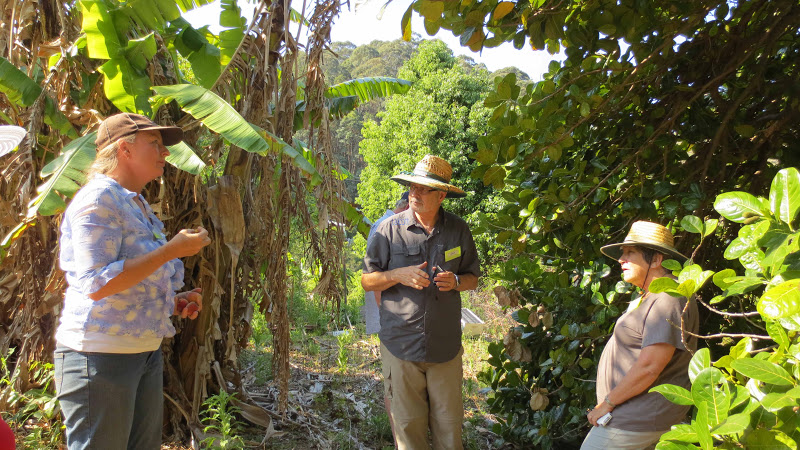
Bellingen Seedsavers visit Susan's banana farm

Susan is aiming at restoring her acquired banana farm to better health. The steep slopes are being planted with seedlings of other fruit trees, especially mango and avocado seedlings. She has stopped all spraying and is planning for certain plants to overwhelm weeds.


 The steep slopes are prone to erosion especially in the high rainfall of the Coffs Coast.


Macadamias grown from the nuts are being propagated for adding to the biodiversity of a food forest.


This mature mango helps to retain the steep slope.


A wild native raspberry flourishes. Some find these fairly tasteless but others enjoy the taste. Be careful to control the runners.


Coriander, in the vegetable garden, flowers and attracts useful insects. 

Fennel grows well at this time of year.


Silver Beet produces more when the outside leaves are regularly picked.


This Jack Fruit has been producing fruit for some years. With no extra irrigation it is surviving the very dry weather....


.... and producing fruit.


This joey was found in the pouch of its mother, killed on a road. Here he attempts to climb into a non-existent pouch


These gluten free pumpkin, feta and sun dried tomatoes were enjoyed at afternoon tea.


Irene grew this whopper of a pineapple. The size surprised us, our climate not being really subtropical.


Hong Kong Taro is a smaller variety of taro. Irene had brushed off the soil gently, and brought the taro to the boil in cold water with salt and five spice powder.

She simmered the covered pot for 10 minutes then left the taro in the water to cool. This made it easy to peel the taro which tasted like a waxy boiled potato. The boiled taro would make an excellent 'potato' salad. The taro could be stored unpeeled in the 'fridge for a week.

As usual we shared plants and seeds from our seed table.


The new vegetable garden is well mulched in this dry weather.


The early ripe fruit on this peach tree is because of the north facing slope and our latitude.


We plan for our next garden visit to be to Bellingen's North Bank Community Garden on the second Thursday of November, November 8.


LinkWithin


Related Posts Plugin for WordPress, Blogger...

LinkWithin

Related Posts Plugin for WordPress, Blogger...