About Bellingen Seedsavers

We are a group of like-minded growers of edible and useful heritage plant varieties in the Bellingen area of northeast New South Wales, Australia.

Our climate varies from frost-free coastal areas to inland river valleys and highlands with frosts. Bellingen has an average annual rainfall of 1507ml.

Sunday, 18 March 2012

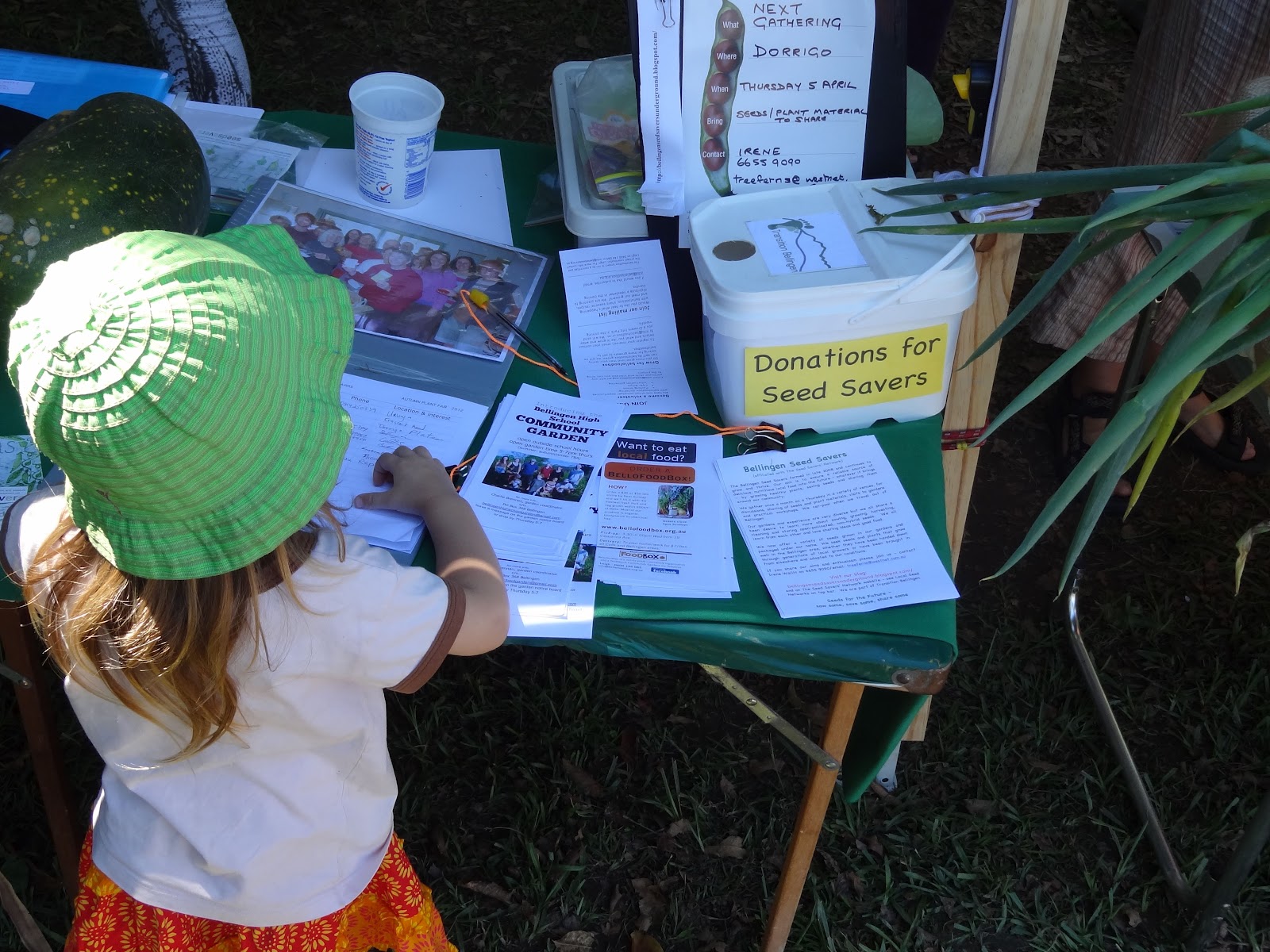
Bellingen Seedsavers at the Bellingen Plant Fair in March

A successful raffle of organic produce

Hi Seed Savers

Congratulations and huge thanks to everyone associated with our stall at the Plant Fair:  all the willing workers who participated in the seed-packing working bee;  propagated plant material and provided lovely home grown produce for the raffle prizes;  helped to set up the stall and the surrounding area and pack up at the end.  It was very satisfying to see the rather bare area when it was all over.  Hundreds of seeds are now in the hands and soil of the visitors, who I very much hope will "save some, sow some and share some".  The level of enthusiasm of visitors to the stall was overwhelming - it increases with each one. 

We will need to work hard to harvest seeds from our gardens to replenish our stocks for the Spring Plant Fair, so please save some of your best seeds for that purpose. 

Have you seen the kind words and great photos that Jude and Michele Fanton have on their website about their visit in September? :  http://www.seedsavers.net/seed-blog/workshops-bellingen-seed-savers-september-2011.  Cheers Irene

Busy, busy,busy


Click a pic to view pics in a slide show
A list of available seeds packaged by Bellingen Seedsavers


Some of the available plants


We appeal to all ages


A closer shot of the produce


More plants


More customers and staff


Bellingen High School Community Garden  holds working bees each Thursday 5pm. Details available at: working bees  


Siddhanta Hazell, teacher of Organics and Horticulture at TAFE for the last 10 years, will be offering free fruit and vegetable gardening advice at the Bellingen High School community garden on Thursdays from 5-6pm. People can bring their pests and diseases, their soil samples, their weeds, their worries, whatever. This service is part of the Garden's weekly gardening time for the general public, when you can get hands-on and dirty with garden tasks if you so desire or just wander and harvest and enjoy the burgeoning garden.Tools and equipment and tea making facilities available. The Garden entrance is off Crown St. See you there!


Food Exchange - Permaculture Collective MNC
10.30-12.30 Thursday 29 March - Church Street, outside Kombu (and alternate Thursdays)

Bellingen Seed Savers at Autumn Plant Fair 2012

Bellingen Seed Savers enjoyed another successful Plant Fair on Saturday 10 March - with huge interest from the public, perfect weather and many plants and seeds shared with our community.  Many thanks to all our members who worked on and before the day and/or, donated their plants, seeds and produce for the ever popular raffle.


Saturday, 25 February 2012

Perennial Staple Crops of the World

Coppiced mulberry leaf on contour at Las CaƱadas for human food and
goat fodder. Overstory of nitrogen-fixing acacias.


Perennial Staple Crops of the World

This is a link to a website with some very useful information about some of the food crops we can or may be able to grow in our Bellingen locality.

Here is a tiny sample of this extensive information source.

Chaya/Tree Spinach (Cnidoscolus chayamansa), or Mayan spinach, is a shrub of the tropics and subtropics. It tolerates arid to humid conditions, in lowlands and highlands. Though raw leaves contain cyanide, the cooked leaves are very nutritious. Yields are very high, 20-30 tons per hectare fresh.

Katuk/Sweetleaf (Sauropus androgynous) is an Asian shrub with delicious leaves. Unlike most woody leaf crops it can be eaten raw. It likes humid tropical lowlands and thrives in the shade of fruit and nut crops. The protein content of fresh leaves is 6-10%.

Moringa/Drumstick Tree (Moringa oleifera, M. stenopetala) is a small tree of the tropics, thriving in arid and humid climates. The dried leaf is incredible nutritious, and used by nursing mothers in much of the tropics. If allowed to grow to tree form moringa produces nutritious pods, but for leaf production it is coppiced. Yields of moringa leaf are very high, 10-50 tons per hectare.

See also  SurvivalGardener.com

Tuesday, 24 January 2012

Recipe for a very mild Sambal

This recipe uses local plants and spices. If you like a hot sambal add more chili.


Perennial Garlic at the reshooting stage

Perennial Capsicum, small but prolific

Lemon Grass

Rocoto Tree Chili - very hot

Galangal
Ingredients:

- One clove of perennial garlic
- Quarter of a hot chili
- A good handful of small red perennial capsicums or use a large capsicum
- 1/4 teaspoon dried nutmeg powder
- 1 onion, preferably mild, peeled and chopped
- 1 teaspoon salt
- 1 1/2 teaspoons-  chopped palm sugar

- dash of coconut oil. Coconut oil adds flavour. Don't use olive oil
- 2 Curry Tree leaf bunches
- 2 Lemongrass stems, bruised
- 1 cm Galangal, peeled and sliced. Fresh ginger could substitute.
- 2 tablespoons Tamarind paste or substitute lime juice
- 2 tablespoons salt

Directions

1. Combine first seven ingredients and grind or blend finely. If you are not bothered by a more fibrous sambal you can also blend the lemon grass and galangal added in the next step.

2. Heat oil and saute ground ingredients together with curry tree leaves, lemon grass and galangal, stirring until the mixture changes colour. Add tamarind juice and simmer for another minute, then leave to cool.

3. Remove curry tree leaves, lemon grass and galangal before serving.

4. It will last at least a week in the refridgerator.  I use a large dollop to stir-fry climbing or bush beans but use to stir-fry any suitable vegetables such as baby chokoes.

This recipe was an adaptation of an asian recipe. You can experiment and vary the ingredients to taste.

Saturday, 21 January 2012

January Fruiting in the Bellingen Area

Here are a few of the plants fruiting in this area at this time.

 This White Sapote has yielded a few fruit and as you can see there are more on the way as they seem to ripen over a few months. Bagging against fruit fly is necessary.

The cucumbers are at their most productive.
 Black Kale (Dino Kale, Cavallo Nero) are still producing fresh leaves although the older leaves are well nibbled by the white cabbage moth.

Keeping the birds away from the ripening grapes can be a chore.
 These Perennial Capsicums are small but prolific at a time when capsicums can be quite costly.

Rhubarb does not like much heat but the weather has been more wet and humid than hot and sunny.

It is time to dig the Cassava.
 The bush Butter Beans are adding to the climbing beans and Snake Beans which have been producing since Christmas.
 This Cranberry Hibiscus was a surprise seedling. A few young leaves added to the salad bowl taste like sorrel, contributing a slight lemony flavour.
At present this Mountain Paw Paw drops its fruit before they reach a useful size.


This Wax Jambu is producing loads of crisp, crunchy, moist fruit. These are great to eat fresh but not to everyones taste. Wax Jambu would really contribute to an asian salad with a lime juice dressing.


 This tamarillo has been fruiting for a month. If grilled, like a tomato,  a Tamarillo will add flavour to the breakfast plate.

The first of the Wing Beans are ready to pick before they become too big and full of fibre. These plants have regrown from the 2010, 2011 tubers.
This is a moth eaten leaf but the tiny sprouts of Purple Sprouting Broccoli are still being produced.
 The sweet basil loves the humid warm weather.
 The New Guinean Mushroom plant also likes some rain, heat and shade.

 The ginger has been shooting for six weeks now. It loves this weather and is growing in shade beneath the Tiger Grass.
 The unblanched celery is tough but softens when cooked.
The Snake Beans love the heat. Why do they attract so many ants? Picking each bean with a twist, so the growing point will fruit again, has contributed to the yield.  What is fruiting in your garden at this time?

Saturday, 14 January 2012

Bellingen Seedsavers visit 'Ohana' at Thora


Rob shows us around his large garden. Click on any pic to enlarge.

Thora is about ten minutes drive west of Bellingen. Kirsten and Rob welcomed us and shared their large vegetable garden and orchard with us. The area has been reclaimed from weedy Lantana which had climbed five metres into the fruit trees. Rob and Kirsten used goats, horses and human power to clear the land and discovered the mature fruit trees. The garden, previously cultvated and now enriched with plenty of animal manure is very productive. You can see more of Rob and Kirsten's garden at www.ohanathora.blogspot.com.


The rich soil has been sculpted into vegetable beds.


Amaranth provides Kirsten and Rob young leaves for a salad


The tomatoes are protected from birds with nets

Rob grows large quantities of parsley.

Yellow Evening Primrose provides flowers for a salad.


Yellow Zucchine

Water melon

Egyptian Spinach seedlings


Seedling Black Walnut

Black Walnut trees provide shade but not fruit. Apparently they are also useful for rootstock.


A large unpruned plum.

A fruiting Persimmon

This mature Nashi Pear is loaded with fruit.


Mature Feijoas

A 1.5m resident goanna checked on our presence.


LinkWithin


Related Posts Plugin for WordPress, Blogger...

LinkWithin

Related Posts Plugin for WordPress, Blogger...