About Bellingen Seedsavers

We are a group of like-minded growers of edible and useful heritage plant varieties in the Bellingen area of northeast New South Wales, Australia.

Our climate varies from frost-free coastal areas to inland river valleys and highlands with frosts. Bellingen has an average annual rainfall of 1507ml.

Monday, 21 November 2011

Snapshot: November Edibles in northern NSW, Australia

It is mid spring in our November gardens. In this climate, on this north facing block, it is early summer. Click on any pic to enlarge.

The taro is in full leaf and grew throughout our mild winter. 


Pink Brugmansia in front of Arundo Donax. The Arundo is useful as a source of mulch.


This Wax Jambu has just burst into flower. The fruit are crisp and moist.


A thorny Globe Artichoke has been left to flower but is delicious eating.


This Rose Apple was planted during winter under a wattle that will soon 'kick the bucket'. It has yet to start new growth.


A Tamarillo (Solanum betaceum (syn. Cyphomandra betacea) has already yielded a few fruit, its first crop. As yet Fruit Fly has not attacked this fruit and the plants are very productive in this Bellingen climate.


  This Mangosteen was planted in autumn in a swampy part of a north facing slope. So far it likes its position but has not yet put on growth.

 The choko vine is beginning to cover the poultry fence.
 The White Mulberry has been fruiting for a few weeks. Birds have not yet recognised the ripe fruit (white to pale green) as ripe and have left the fruit for us. The flavour is extremely sweet and many prefer the black, common mulberry for taste.
 Two Burdekin Plum trees (Pleiogynium timorense)
 are growing strongly. Native to Australia the fruit requires treatment to increase palatability.

 Natal Plum (Carissa macrocarpa) is starting to flower for the first time. These plants were planted two years ago. The white flowers (like a small Gardenia flower) have a sweet smell. The plant is neat and very prickly.

This Fuju Persimmon is growing strongly again after dropping its leaves over winter.


A tropical peach looking quite miserable. Tip borer attacks this tree each year and prunes it. The Lomandra grass behind the tree is to edge the terrace.


 Two Davidson Plums grow strongly.


An apricot has yet to flower despite its growth.

A Grumichama yielded a few fruit last year. They grow well in this climate.


This Longan tree finds the soil dry and poor despite its heavy mulch. The pine trees above it rob the soil of nutrients. Another location is required.


 This Star Gooseberry (Phyllanthus acidus), is also known as the Otaheite gooseberry, Malay gooseberry and Tahitian gooseberry. It has the same name as Sweetleaf, (Sauropus androgynus) which is confusing. This tropical plant has struggled with our mild winter and is only starting to regain its leaves. Perhaps it will last the next winter with leaves because of its growth. The Gota Kulu herb has almost swamped this plant.


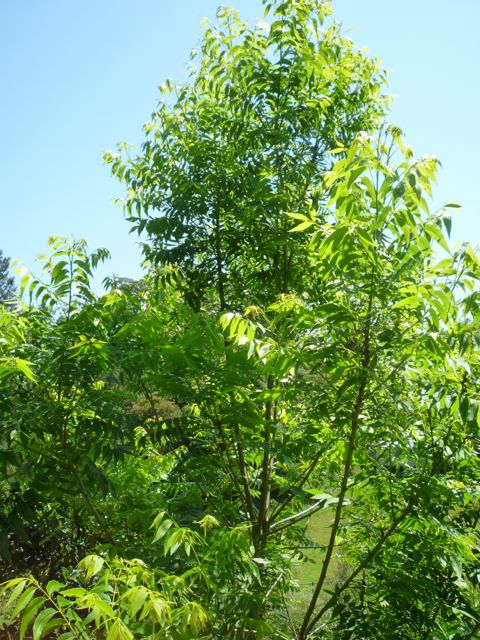
Pecans grow strongly in this climate


This native lime bush produced many fruit last summer.


A young Rosella will need every warm day to produce its fruit. The fruit is excellent for jam making.


This 2.5m Black Sapote is growing strongly and may fruit this year.
 A variety of edible figs survive this wet climate and produce fruit.
  A Cavendish banana in fruit.


A Soursop regains its leaves after the winter defoliation and dieback that affects many tropical trees in our winter. 
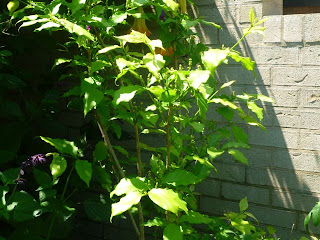


The Peanut Butter tree (Bunchosia) likes its warm wall and has produced a few fruit.


This Myrtus ugni is growing reasonably quickly but is yet to fruit.


The Mushroom plant is in flower.


Vetiver grass retains this steep slope and is also cut for mulch.


Day lily flower buds can be added to stirfries.


This yellow guava produces small, sweet fruit.


The variegated water parsley loves the edge of the pond and tastes like parsley.


The Kang Kong has survived the winter cold and is starting to grow across this pond.


I still find the leaves of this Brazilian Spinach very leather, but it is useful as a summer salad green.


This annual Amaranth does produce some mild tasting salad leaves.


 Oca (Oxalis tuberosa) growing from a yam purchased from a local store in winter.

Close up of a Cape Gooseberry bush. If you look carefully you can see an immature fruit in its green casing (cape) which unfortunately do not protect the fruit from birds or Fruit Fly. Still this plant is extremely productive and delicious stewed with only a little sugar. "Native to high-altitude, tropical Colombia, Chile, Ecuador and Peru, where the fruits grow wild, physalis is casually eaten and occasionally sold in markets." Wikipedia.

The Boysenberries are fruiting heavily. These plants were established in late summer last year and the boysenberries have swamped the Youngberry and Raspberry also growing on the trellis. So far the birds are leaving plenty for us.


This sharp thorned Kei Apple is yet to fruit. To persuade me tokeep these two plants (hopefully one male and one female) the fruit will need to be superb because this plant is an eye hazard.


Sunday, 20 November 2011

Irene's November Newsletter


Hi Seed Savers

It's almost Summer and we are galloping towards the end of the year but we can still look forward to our  December Gathering at Bec's home in Bonville from 1pm on Thursday 1st.  This will be our first time in that direction and this should please those of you who have to travel along the Highway from the north or the south.  I'm sure we will have a great time at Bec's and hope you can come.

The weather was kind to us for our last Gathering  in Fernmount and everyone was in awe of what John and Carol have achieved and there are some photos on the blog.  Many thanks to John and Carol for their lovely hospitality and for sharing their beautiful garden with us.
  
We had a particularly interesting mix of seeds* and plant material to share with one another we welcomed lots of new people attending their first Gathering. It was lovely to welcome Dean and Teal, from the Bellingen High School garden and, on behalf of BSS,  I presented them with a copy of The Seedsavers' Handbook.  This book is invaluable and I still have a few copies available for $22 for BSS people.

How we have grown in the three years since five people attended the very first Gathering - from 5 to 208 on our mailing list!  There are a couple of points that I would like to highlight - the first is that we had no idea that we would experience this sort of growth.  The level of interest that we receive from people at plant fairs and other events has risen with each one - it was overwhelming at the Spring Plant Fair this year.  Our main aim is to ensure future food  security in our community and we do this by saving the seeds from our best plants and sharing them around. We have a wide variety of micro-climates in our individual gardens and if someone experiences a failure of a valued crop in their garden, we need to be in a position to provide replacement seeds.   The more varieties of resilient seeds we have available, the better.  Many of the old heritage varieties have disappeared.  We notice that seed suppliers' lists of offerings develop gaps.

In addition to our gatherings, we distribute large quantities of seeds and plant materials at our stalls.  The higher the level of interest from the public, the greater the quantity and varieties we need to be able to offer and this is where we rely on our members to play their part.  We have founding members, who have been saving and sharing seeds for the last three years (some for many more), and we also have new people constantly  joining us, who have enormously varied backgrounds and experience in gardening and seed saving.  We are delighted to welcome everyone.  It takes a little while to get into the swing of seed saving but it is so rewarding.

We are all volunteers and we all enjoy our garden visits, where we can learn from one another.  For the first time this year we were very happy to have Jude and Michel Fanton, the Founders of The Seedsavers' Network, spend a week-end with us, sharing their expertise.  This was very successful and this event and future presenters are funded by our activities at plant fairs and other events.  We work very hard to ensure that we have an attractive, informative stall laden with packets of seeds, plant materials and all sorts of goodies from our gardens.   We are totally self-funded.  Obviously, the more people who contribute, the more it spreads the load - and the joy.

*Labelling of seeds and plant materials.
The bigger our 'membership' becomes, the more important it is that the seeds and plant materials we share at Gatherings are labelled (see attachment).   If you do this before setting out to a Gathering, it saves confusion as the share table is often very crowded.  It is so easy to arrive home and find yourself with anonymous packages - so frustrating!  If you include details of your name as well as the seeds, their origin, plus any specific information needed to raise them successfully, we can all keep track.  I am attaching the label that you can complete (as far as you are able). You will see that one of the questions asks whether you are willing to 'adopt a seed'.  This means you are willing to ensure that you grow sufficient numbers of the variety and can ensure that they are protected from cross fertilisation, so that when we label the package we can be reasonably sure that it contains what it says.

2012 Gatherings
I would love to hear from anyone who would like to offer their garden for a Gathering next year.  We enjoy all sorts of gardens - and they don't have to be immaculate.  We all live in different settings and no two are the same -  and there is so much to learn from experiencing them all.  We can bring everything we need (cups, food, chairs, etc.) and some of us are happy to offer to help with some gardening while we are there.

I am just re-reading a favourite book by Margaret Simons called 'Resurrection in a Bucket - the Rich and Fertile Story of Compost".  I love this quote she uses by Simon Schama:  'The sum of our pasts, generation laid over generation, like the slow mould of the seasons, forms the compost of our future'.  Ah, compost - to be treasured.

Please ensure that you let me know if you are coming to the next Gathering in Bonville on Thursday 1st December - by Monday 28 November, so that I can send you all the directions in good time (I received 14 enquiries in the last day or so before the last gathering.  I think it is only fair to let the host know how many people to expect in good time.

Looking forward to seeing you at our end-of-year Gathering.

Cheers
Irene


Friday, 18 November 2011

Gathering at John & Carol's, Fernmount, 3 November 2011

Forty Bellingen Seed Savers were delighted to explore the flowing design and the enormous variety of edible and decorative plants in John and Carol's garden.


It was beautifully cool on the bamboo-shaded path.


John explains the finer points of the many rare fruit trees he collects.


The dense planting discourages weeds.

Carol explains how to recognise a ripe Cape Gooseberry

Paths zigzag down the hillside

The vegetables to be frequently harvested grow close to the house.


The raised vegetable beds below the verandah are very accessible

At every BSS Gathering many seeds and plant materials are shared


Answer to a question asked at our gathering:

"The easiest, safest and most useful organic-approved fungicides are based on cupric hydroxide. Cupric hydroxide controls a wide range of problems effectively, but unlike older preparations, like Bordeaux or lime sulphur, it can be used at any time. Do not substitute with copper oxychloride, which is not organic."


Friday, 14 October 2011

Irene's Newsletter

Hi Seed Savers

We had a wonderful visit to Carol's garden last week and were all delighted by the design, the collection of orchids, bromeliads, succulents, irises and the excellent use of groundcovers - and much, much more.  If you go to the blog you will find that John has posted many photos of this picturesque garden.  A big thank you to Carol for inviting us and many congratulations for the years of dedication that she has put into the garden.

We were lucky that the rain held off until after our tour of the garden and we then enjoyed tea and conversation,  a debriefing on the recent events and a lively Q&A session.  I was happy to share the news that, despite some reasonably large expenses recently, our bank balance remains very healthy.  All the donations received at the Plant Fair, etc. and the expenses of the Fantons' visit balanced out very well.  

It was agreed that we benefitted greatly from the Fantons' input and a  few suggestions were made as to other experts who might be willing to share their knowledge with Bellingen Seed Savers next year, e.g. Jackie French, Jerry Coleby-Williams, Isobel Shepherd, a local edible weed expert, etc.  If you would like to suggest others or specific topics you would like covered, please let me know.    I will start making enquiries.


Q & A sessions have become a regular part of our Gatherings and give us an opportunity to pick up some useful practical tips from one another.  I sometimes receive cries for help between Gatherings too and here are a couple of recent ones which were discussed last week:

1. Q  from Rhonda - After one of the gatherings I struck some elderberry pieces and they are now planted in the garden.  However I did not check how big they grow and may have put them in the wrong spot.  Not sure who bought the plant to the meeting but if you have time and think about it could you ask the group via email, how big it grows, I’d much prefer to transplant it now than later. 
 A from Elaine -

The Elder, ( Sambucus nigra )...has more Folklore attatched to it, than any other European plant.....and can grow to 10 metres depending on conditions.

 I like to cut them back to just above a metre, and keep pruning the tips, to produce more flowers and berries, and allowing them to grow to just over 2 metres, makes harvesting easier.    However I like to leave some, for support for the aerial potato, and creating a micro climate, for underplanting, to protect plants from extreme conditions of heat and cold.  Pruned they also make a fast growing wind-break.
The FLOWERS treat, all Respiratory and inflammatory conditions, colds, sore throats, hayfever, feverish illnesses, arthritis and are a mild laxative.
The Berries, are rich in Vitamin C and flavenoids, with antiviral and immune enhancing actions.  Strengthen the eyes and improve night vision.
 Both Fruit and Flowers have been traditionally used in TEAS Cordials Jams and Jellies Wines and Anti -  ageing formulas...hence the name ELDER.
 ELDER FLOWERS AND OR BERRIES  with yoghurt,  make an excellent addition to the morning MUESLI. 
 A brew of the leaves is a good insecticide.

2. Q from Lesley -" I've always had good success with dwarf beans but this year something is eating my seeds as they're emerging from the ground. Those that come up at all have brown edged holes in the cotyledons and don't make it to becoming a plant. Do you know what's doing it? More to the point, what can I do about it?"


 A from group - a number of protection methods were suggested - a piece of polypipe or an upturned drink bottle, pushed into the ground around the seedling.
Causes suggested - birds, slugs/snails, 4-legged creatures......

3. Q  from someone in the group - a Brazil Cherry - flowers but no fruit
    A  Could have been the period of wet weather

If you have a query about something you are growing, please send it in and I will circulate it.

Thursday, 13 October 2011

Bellingen Seed Savers Visits Carol's Coronation St Garden


Our group really enjoyed visiting a town garden. This garden was packed with surprises. As we approached we could see that Carol has fully utilised her nature strip.
 Old Man's Beard is draped on a Frangipani branch.


Carol has collected many succulents, ...


... orchids and bromeliads.
 Her monster Birds Nest Fern has been growing here for many years.  This fern is native to the rainforest around Bellingen.
 It gathers forest debris, in its spreading fronds, which then decompose to feed the fern.
 Some of us enjoyed a cup of Carol's Stinging Nettle (Urtica dioica) tea. Carol grows the nettles in a pot to prevent this invasive plant becoming a weed.


One of Carol's many orchids thriving in the semi-shade.


 Carol grows comfrey and a variety of vegetables in a long raised bed with bird-netting stretched over polypipe. Comfrey is an excellent additive to compost and also makes a mulch rich with the minerals it mines with its deep roots.


This golden day lily loved its sunny northern position.


In this pic you can see an aloe, a rose and a native banksia all growing happily in Carol's front yard. She has also extensively planted her nature strips outside her fences.


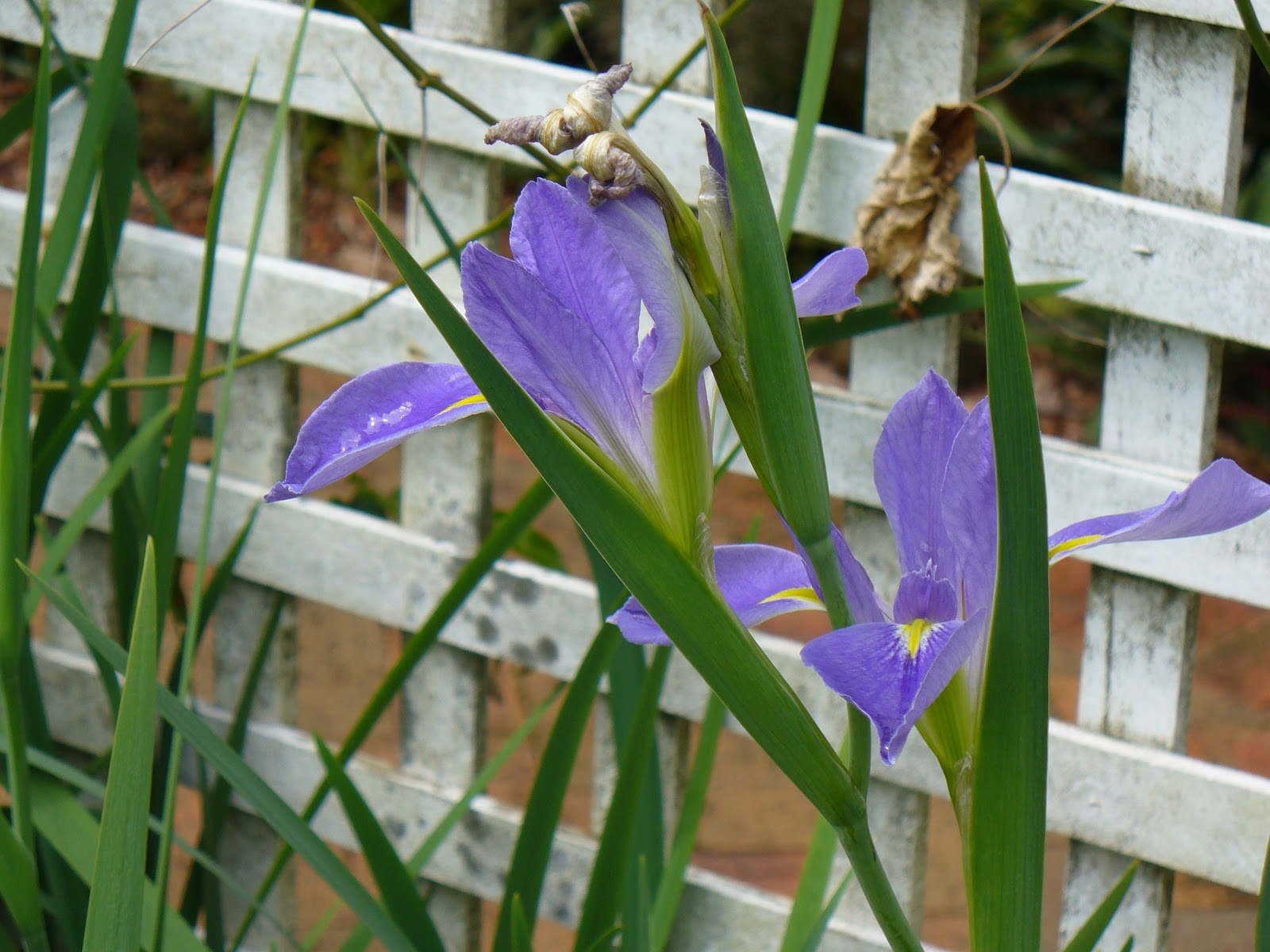
Irises grow by the pool with a crucifix orchid in the foreground. We thinks these are Lousiana Iris.


 Here is a blue Lousiana Iris which is growing happily in soil.

Calla Lilies make an easy care groundcover, easily contained in a town garden.


Carol shared her years of gardening experience.


 Carol has collected many succulents and uses them here as groundcover.
 Her raised, netted vegetable area provides a steady supply of vegetables and herbs.

 Mustard grows in the vegetable garden...
 ...as does Italian Parsley.


 A view of the Dorrigo escarpment from Carol's front garden.


 More of Carol's succulents.


The naked branches of the large Frangipani.


A very, large Magnolia (not Magnolia grandiflora) provided shade. On the left is a mature Frangipani still to come into leaf. Click on all pics to enlarge.

Wednesday, 28 September 2011

Next Gathering:

Thursday 6 October 1pm  
Coronation Street, Bellingen

This will be a lovely place to spend a Spring afternoon.  This mature garden is delightful and quite different from any that we have been to before.  The extensive use of pavings with a huge raised and netted herb and vegetable bed, surrounded by densely planted borders, makes for a low maintenance, creative garden.  There is a lot to learn in this garden and I hope you can come and enjoy it.  One of the delights is the sound of the water feature.

Please let me know if you can be there.  It is very helpful to our host to have a reasonable idea of how many people to expect.  I will send the address and let you know of anything you need to bring.

Cheers
Irene

Thursday, 22 September 2011

Jude and Michel Fanton visit Bellingen Seedsavers

Once again we visited David's large garden which he most generously allowed as the venue for a Jude and Michel Fanton Seedsavers Workshop. Jude and Michel founded the international seedsavers movement which is headquartered in Byron Bay, NSW.


One activity involved finding the most perfect pea pod to save for seed.


Under the shade of the trees, on an unusually hot spring day, Jude and Michel explained many of the mysteries of seedsaving.


The workshop finished with the group learning how to clean seeds using various sieves.


We all brought along seeds and plants for a 'show and tell' session. As usual, Nell was a fount of knowledge. Here she is describing the excellent properties of a Fijian Taro that she has grown for many years. We also learned that the shoots from Arrowroot (Canna edulis) can be eaten when prepared like asparagus.


Nell mixes the cooked Taro with coconut milk to make a tasty dip or spread.


Much of the food brought along to share was grown by members of our Bellingen Seedsavers Club. Lemons, peanuts, mandarins, paw paw, grated green paw paw and bean shoots were just some of the home grown edibles used in cakes, salads and dips.


Peter brought along his pickled walnuts and they were indeed exceptional. Here they are served with crackers and cheese. His large tree is around ten metres high.


The chilacayote (Cucurbita ficifolia) the melon-like fruit, was new to many of us. Like a pie melon, this fruit is probably best used as a zucchini when small, according to our experienced members. The flesh was white and slightly sweet. You need never starve with 'killer chayotes' in the trees. Just watch your head if you allow them to grow high into the trees.


Colourful nasturtium flowers decorated this salad.


Nell  made this salad with grated green paw paw and sprouts with a lemon-juice and honey dressing.

LinkWithin


Related Posts Plugin for WordPress, Blogger...

LinkWithin

Related Posts Plugin for WordPress, Blogger...